

Regular Articles

Supply-demand matching of wind and solar energy systems on the Tibetan Plateau under climate change scenarios

  • MUHADAISI Airiken , 1, 2 ,
  • LIU Lai-bao 3, 4 ,
  • LI Shuang-cheng , 1, 2
Expand
  • 1. College of Urban and Environmental Sciences, Peking University, Beijing 100871, China
  • 2. Key Laboratory for Earth Surface Processes of the Ministry of Education, Peking University, Beijing 100871, China
  • 3. Department of Geography, The University of Hong Kong, Hong Kong 999077, China
  • 4. Institute for Climate and Carbon Neutrality, The University of Hong Kong, Hong Kong 999077, China

Received date: 2024-09-02

  Revised date: 2025-01-20

  Online published: 2026-01-14

Abstract

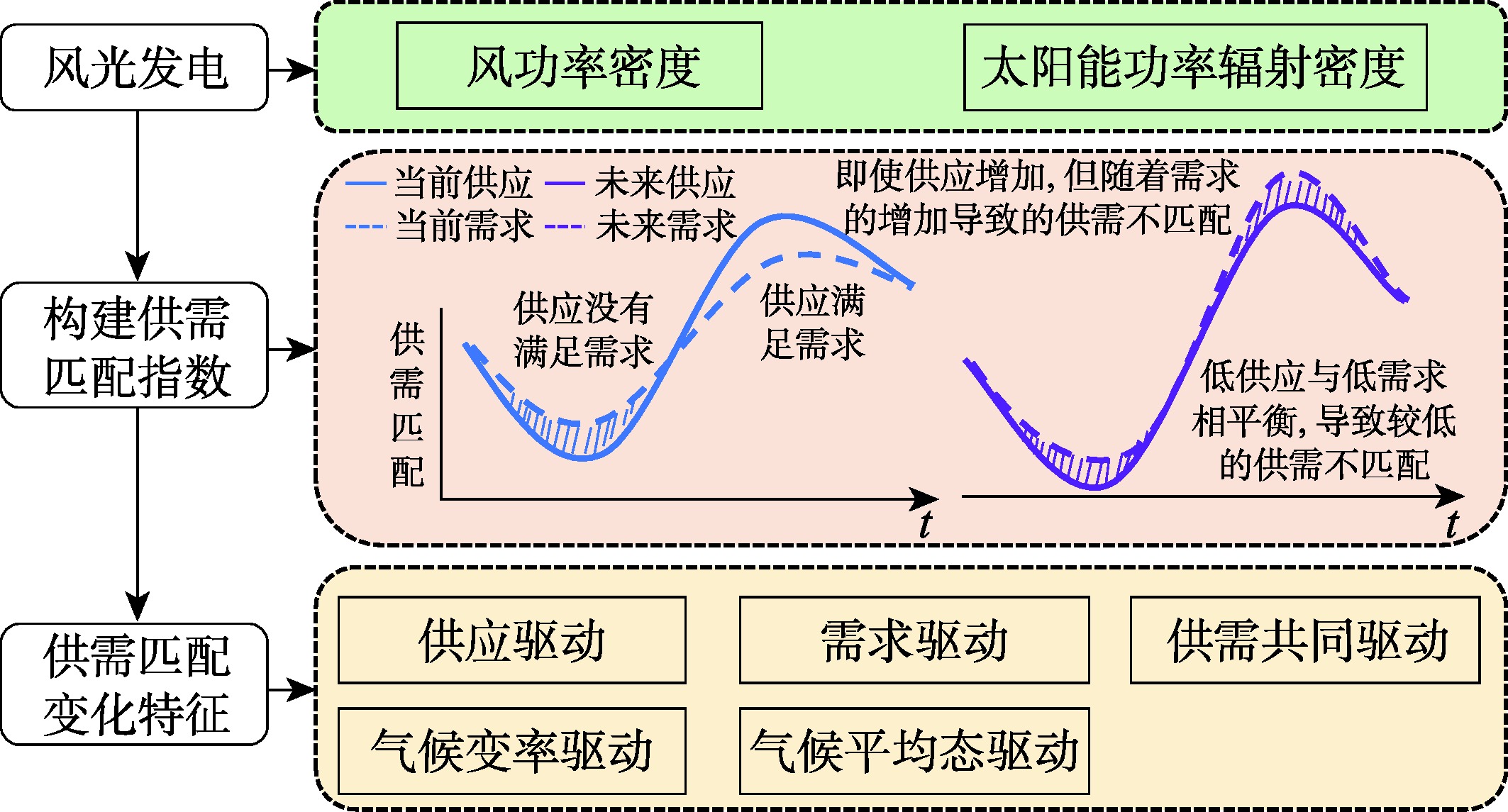
Climate change can influence both energy supply and demand. As a critical strategic resource reserve for China, the Tibetan Plateau lacks comprehensive research on the future alignment of electricity supply and demand from wind and solar (W&S) energy systems under climate change scenarios. This study develops a supply-demand matching (SDM) index using outputs from 12 global climate models and evaluates the independent and combined effects of climate change on supply, demand, and changes in SDM (∆SDM) through controlled experiments. The results indicate that under the SSP2-4.5 scenario, W&S system supply, driven by shifts in climate mean states, shows a declining trend. For wind energy systems, ∆SDM decreases by an average of -2.95%, driven by the combined effects of supply and demand changes. Conversely, for solar energy systems, ∆SDM increases by an average of 2.02%, primarily due to a reduction in future heating demand, which offsets the decline in solar energy supply and enhances the supply-demand matching of solar energy systems. This study provides a scientific foundation for the Tibetan Plateau's energy sector to adapt effectively to climate change.
Cite this article

MUHADAISI Airiken , LIU Lai-bao , LI Shuang-cheng . Supply-demand matching of wind and solar energy systems on the Tibetan Plateau under climate change scenarios[J]. JOURNAL OF NATURAL RESOURCES, 2026 , 41(2) : 627 -642 . DOI: 10.31497/zrzyxb.20260218

[1]
WANG Y J, WANG R, TANAKA K, et al. Accelerating the energy transition towards photovoltaic and wind in China. Nature, 2023, 619(7971): 761-767.

DOI

[2]
DAVIS S J, LEWIS N S, SHANER M, et al. Net-zero emissions energy systems. Science, 2018, 360(6396): eaas9793, Doi: 10.1126/science.aas9793.

[3]
YE H F, PENG H W, LI C H, et al. A demonstration concentrating solar power plant in China: Carbon neutrality, energy renewability and policy perspectives. Journal of Environmental Management, 2023, 328: 117003, Doi: 10.1016/j.jenvman.2022.117003.

[4]
SWEERTS B, PFENNINGER S, YANG S, et al. Estimation of losses in solar energy production from air pollution in China since 1960 using surface radiation data. Nature Energy, 2019, 4: 657-663.

[5]
邓铭江, 明波, 李研, 等. “双碳”目标下新疆能源系统绿色转型路径. 自然资源学报, 2022, 37(5): 1107-1122.

DOI

[DENG M J, MING B, LI Y, et al. Pathways towards a cleaner energy system for Xinjiang under carbon peak and carbon neutrality goals. Journal of Natural Resources, 2022, 37(5): 1107-1122.]

DOI

[6]
国家能源局. 国家能源局发布2023年全国电力工业统计数据. 电力科技与环保, 2024, 40(1): 95.

[National Energy Administration of China. The National Energy Administration released the national power industry statistics for 2023. Electric Power Technology and Environmental Protection, 2024, 40(1): 95.]

[7]
鲁玺, 李丹, 秦海岩, 等. 中国碳中和目标下的风光技术展望. 北京: 清华大学碳中和研究院, 2024, https://www.icon.tsinghua.edu.cn/info/1070/1436.htm.

[LU X, LI D, QIN H Y, et al. Technology outlook on wind and solar power toward China's carbon neutrality goal. Institute for Carbon Neutrality. Beijing: Institute for Carbon Neutrality, Tsinghua University, 2024, https://www.icon.tsinghua.edu.cn/info/1070/1436.htm.]

[8]
JEREZ S, TOBIN I, VAUTARD R, et al. The impact of climate change on photovoltaic power generation in Europe. Nature Communications, 2015, 6: 10014, Doi: 10.1038/ncomms10014.

DOI PMID

[9]
LEI Y D, WANG Z L, WANG D Y, et al. Co-benefits of carbon neutrality in enhancing and stabilizing solar and wind energy. Nature Climate Change, 2023, 13: 693-700.

DOI

[10]
GERNAAT D E H J, DE BOER H S, DAIOGLOU V, et al. Climate change impacts on renewable energy supply. Nature Climate Change, 2021, 11: 119-125.

DOI

[11]
LIU L B, HE G, WU M X, et al. Climate change impacts on planned supply-demand match in global wind and solar energy systems. Nature Energy, 2023, 8: 870-880.

DOI

[12]
PRYOR S C, BARTHELMIE R J, BUKOVSKY M S, et al. Climate change impacts on wind power generation. Nature Reviews Earth & Environment, 2020, 1: 627-643.

[13]
FERON S, CORDERO R R, DAMIANI A, et al. Climate change extremes and photovoltaic power output. Nature Sustainability, 2021, 4: 270-276.

DOI

[14]
PRYOR S C, BARTHELMIE R J. A global assessment of extreme wind speeds for wind energy applications. Nature Energy, 2021, 6: 268-276.

DOI

[15]
WOHLAND J. Process-based climate change assessment for European winds using EURO-CORDEX and global models. Environmental Research Letters, 2022, 17(12): 124047, Doi: 10.1088/1748-9326/aca77f.

[16]
ALLEN M R, FERNANDEZ S J, FU J S, et al. Impacts of climate change on sub-regional electricity demand and distribution in the Southern United States. Nature Energy, 2016, 1(8): 16103, Doi: 10.1038/nenergy.2016.103.

[17]
VAN RUIJVEN B J, DE CIAN E, SUE WING I. Amplification of future energy demand growth due to climate change. Nature Communications, 2019, 10(1): 2762, Doi: s41467-019-10399-3.

[18]
TANG W J, XU S, ZHOU X, et al. Meeting China's electricity demand with renewable energy over Tibetan Plateau. Science Bulletin, 2023, 68(1): 39-42.

[19]
朱蓉, 孙朝阳, 闫宇平, 等. 青藏高原风能资源与开发潜力. 北京: 科学出版社, 2023.

[ ZHU R, SUN Z Y, YAN Y P, et al. Wind Energy Resources and Development Potential in Qinghai-Tibet Plateau. Beijing: Science Press, 2023.]

[20]
耿垭鑫, 易桂花, 张廷斌, 等. 青藏高原气候变化对草地碳汇/源格局的影响. 自然资源学报, 2024, 39(5): 1208-1221.

DOI

[GENG Y X, YI G H, ZHANG T B, et al. Impacts of climate change on grassland carbon sink/source patterns in the Qinghai-Tibet Plateau. Journal of Natural Resources, 2024, 39(5): 1208-1221.]

DOI

[21]
WU R C, NIU X R, JING X W, et al. Future projection and uncertainty analysis of wind and solar energy in China based on an ensemble of CORDEX-EA-II regional climate simulations. Journal of Geophysical Research: Atmospheres, 2024, 129(6): e2023JD040271, Doi: 10.1029/2023JD040271.

[22]
WANG Y, CHAO Q C, ZHAO L, et al. Assessment of wind and photovoltaic power potential in China. Carbon Neutrality, 2022, 1(1): 15.

DOI

[23]
LIU L B, WANG Y, WANG Z, et al. Potential contributions of wind and solar power to China's carbon neutrality. Resources, Conservation and Recycling, 2022, 180: 106155, Doi: 10.1016/j.resconrec.2022.106155.

[24]
阿旺加措, 郜志腾, 王强, 等. 青藏高原超高海拔地区风能开发试验与生态环境效应分析. 高原科学研究, 2023, 7(4): 1-10.

[NGAWANG-GYATSO, GAO Z T, WANG Q, et al. Analysis on the wind energy developmental experiment at ultra-high altitude and its effect on the ecological environment on the Qinghai Tibet Plateau. Plateau Science Research, 2023, 7(4): 1-10.]

[25]
张镱锂, 李炳元, 郑度. 《论青藏高原范围与面积》一文数据的发表: 青藏高原范围界线与面积地理信息系统数据. 全球变化科学研究数据出版系统, 2014.

[ ZHANG Y L, LI B Y, ZHENG D. Datasets of the boundary and area of the Tibetan Plateau. Global Change Research Data Publishing and Repository, 2014.]

[26]
PRYOR S C, NIELSEN M, BARTHELMIE R J, et al. Can satellite sampling of offshore wind speeds realistically represent wind speed distributions? Part II: Quantifying uncertainties associated with distribution fitting methods. Journal of Applied Meteorology, 2004, 43(5): 739-750.

DOI

[27]
李雁, 梁海河, 王曙东, 等. 基于中国风能资源专业观测网的近地层风切变日变化特征. 自然资源学报, 2012, 27(8): 1362-1372.

DOI

[LI Y, LIANG H H, WANG S D, et al. Study of the near surface wind shear daily variation characteristics based on China's wind power resources professional observation network. Journal of Natural Resources, 2012, 27(8): 1362-1372 ]

[28]
龚强, 汪宏宇, 朱玲, 等. 辽宁省近地层风切变特征研究. 自然资源学报, 2015, 30(9): 1560-1569.

[GONG Q, WANG H Y, ZHU L, et al. Study on the near surface wind shear characteristics in Liaoning province, 2015, 30(9): 1560-1569.]

[29]
IRWIN J S. A theoretical variation of the wind profile power-law exponent as a function of surface roughness and stability. Atmospheric Environment, 1979, 13(1): 191-194.

[30]
WENZ L, LEVERMANN A, AUFFHAMMER M. North-south polarization of European electricity consumption under future warming. PNAS, 2017, 114(38): E7910-E7918, Doi: 10.1073/pnas.1704339114.

[31]
AUFFHAMMER M, BAYLIS P, HAUSMAN C H. Climate change is projected to have severe impacts on the frequency and intensity of peak electricity demand across the United States. PNAS, 2017, 114(8): 1886-1891.

DOI PMID

[32]
ISAAC M, VAN VUUREN D P. Modeling global residential sector energy demand for heating and air conditioning in the context of climate change. Energy Policy, 2009, 37(2): 507-521.

DOI

[33]
DEROUBAIX A, LABUHN I, CAMREDON M, et al. Large uncertainties in trends of energy demand for heating and cooling under climate change. Nature Communications, 2021, 12(1): 5197, Doi: 10.1038/s41467-021-25504-8.

[34]
DE CIAN E, SUE WING I. Global energy consumption in a warming climate. Environmental and Resource Economics, 2019, 72(2): 365-410.

DOI

[35]
中国建筑科学研究院.建筑节能与可再生能源利用通用规范: GB 55015-2021. 北京: 中国建筑工业出版社, 2022: 69-75.

[ China Academy of Building Science. General Code for Energy Efficiency and Renewable Energy Use in Buildings:GB 55015-2021. Beijing: China Architecture and Construction Press, 2022: 69-75 ]

[36]
WU J, HAN Z Y, YAN Y P, et al. Future changes in wind energy potential over China using RegCM4 under RCP emission scenarios. Advances in Climate Change Research, 2021, 12(4): 596-610.

DOI

[37]
XIAO Y K, JI Z M, FU C S, et al. Projection of incident surface solar radiation in China under a climate change scenario. The International Archives of the Photogrammetry, Remote Sensing and Spatial Information Sciences, 2019, XLII-3/W9: 187-194.

DOI

[38]
WU J, HAN Z Y, YAN Y P, et al. Future projection of solar energy over China based on multi-regional climate model simulations. Earth and Space Science, 2022, 9(5): e2021EA002207, Doi: 10.1029/2021EA002207.

[39]
PERERA A T D, NIK V M, CHEN D, et al. Quantifying the impacts of climate change and extreme climate events on energy systems. Nature Energy, 2020, 5: 150-159.

DOI

[40]
BARTOS M, CHESTER M, JOHNSON N, et al. Impacts of rising air temperatures on electric transmission ampacity and peak electricity load in the United States. Environmental Research Letters, 2016, 11(11): 114008, Doi: 10.1088/1748-9326/11/11/114008.

Outlines

/