JOURNAL OF NATURAL RESOURCES >
The impacts of cultural ecosystem services and place attachment on urban residents' environmentally responsible behavior: Banyan tree spaces in Guangzhou
Received date: 2024-12-23
Revised date: 2025-07-03
Online published: 2025-10-31
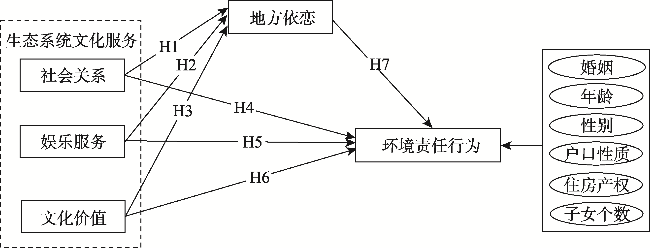
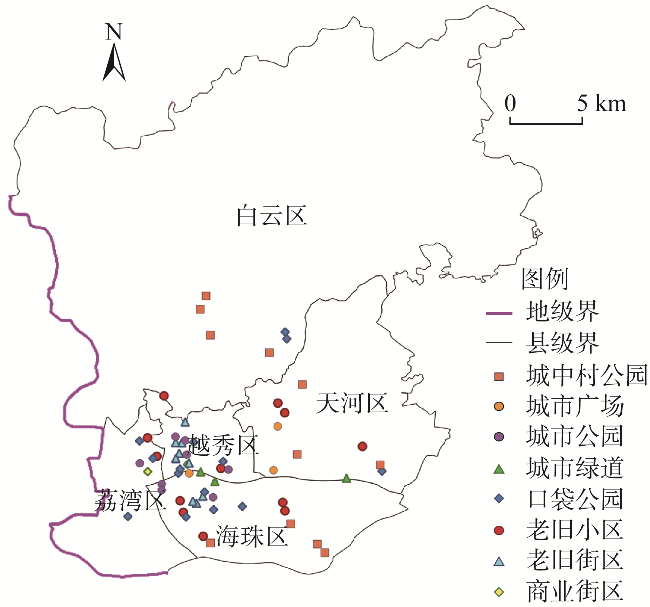
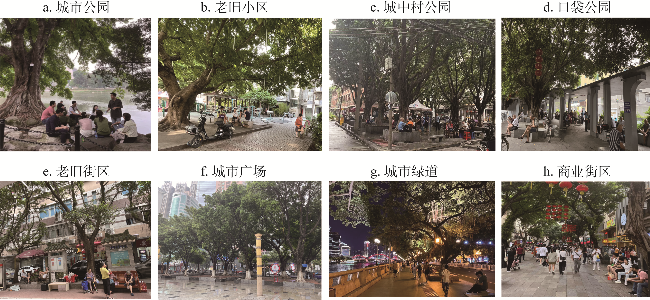
In the context of ecological city construction, residents' environmentally responsible behavior plays a crucial role in enhancing urban environmental quality and fostering a harmonious coexistence between humans and nature. As an important component of the urban ecosystem, urban greening serves as an essential focus for understanding and promoting residents' environmentally responsible behavior. This study investigates the impacts of cultural ecosystem services (CES) and place attachment on residents' environmentally responsible behavior, with banyan tree spaces in Guangzhou serving as the case study. Structural equation modeling (SEM) was used to analyze survey data collected from 1226 questionnaires in 59 banyan tree spaces. The results indicate that: (1) Environmentally responsible behavior is positively associated with the social relations and recreational services dimensions of cultural ecosystem services. (2) The social relations and recreational services dimensions of cultural ecosystem services positively affect place attachment. (3) Place attachment mediates the relationship between cultural ecosystem services and environmentally responsible behavior-cultural ecosystem services influence residents' environmentally responsible behavior through two pathways: social relations-place attachment-environmentally responsible behavior and recreational services-place attachment-environmentally responsible behavior. Overall, our research highlights that focusing on the non-material cultural services provided by urban greening and deepening the understanding of residents' place attachment are essential for optimizing environmentally responsible behavior. Such insights not only provide theoretical guidance for urban ecological construction but also offer practical references for policy formulation and implementation, thereby contributing to sustainable urban development. Therefore, future governments should enhance planning and policy guidance to effectively alleviate conflicts between urban renewal and tree protection. By scientifically and rationally designing green spaces, it will be possible to ensure that ancient and noteworthy trees are fully preserved during urban renewal processes, thereby collectively fostering a more livable and sustainable urban environment.
OUYANG Yi-fei , XIE Di-xiang , CHANG Jiang , HUANG Guo-shen . The impacts of cultural ecosystem services and place attachment on urban residents' environmentally responsible behavior: Banyan tree spaces in Guangzhou[J]. JOURNAL OF NATURAL RESOURCES, 2025 , 40(11) : 2999 -3015 . DOI: 10.31497/zrzyxb.20251107
表1 问卷结构及题目设计Table 1 Questionnaire structure and question design |
| 构面 | 维度 | 题目 | 参考文献 |
|---|---|---|---|
| 生态系统 文化服务 | 社会关系 | SOC1:在榕树空间中邻里相处融洽 SOC2:在榕树空间中的居民很友好 SOC3:我认识榕树空间中的很多人 SOC4:我愿意与他人一道,改善我们的榕树空间 SOC5:我经常和邻居们在榕树空间下一起聊天休息 | Kemperman等[53]、 Cheng等[35]、Jim等[9]、Maleknia等[38]、Dwyer等[54] |
| 娱乐服务 | REC1:榕树空间可以提供健康的活动场所 REC2:榕树空间可以提供接触大自然的机会 REC3:榕树空间可以提供美好的生活体验 REC4:榕树空间可以为城市带来独特的活动场所 | ||
| 文化价值 | CUL1:榕树是广州历史的见证 CUL2:榕树是广州文化的象征 CUL3:榕树代表着广州的景观特色 CUL4:榕树寓意着广州的形象 | ||
| 地方依恋 | 地方依恋 | PLA1:榕树空间已经成为我生活的一部分 PLA2:榕树空间对我来说很特别 PLA3:我对榕树空间的认同感很强 PLA4:我很依恋榕树空间 PLA5:榕树空间很能反映我是怎样的人 PLA6:榕树空间对我来说非常重要 PLA7:榕树空间是最适合我休闲活动的地方 PLA8:对我而言,没有别的户外休闲地方可以和榕树空间相提并论 PLA9:与其他户外休闲地方相比,我对榕树空间更加满意 PLA10:与其他户外休闲地方相比,榕树空间休闲活动对我来说更重要 PLA11:在榕树空间的休闲活动不会被其他的地方取代 | 谢涤湘等[55]、Chang等[56] |
| 环境责 任行为 | 环境责 任行为 | ENV1:当我发现有人在榕树空间中有不环保行为时,我会采取行动来制 止或向管理人员报告 ENV2:我不会在榕树空间中乱扔垃圾 ENV3:在榕树空间活动时,我会保护这里的环境 ENV4:我会遵守这里的环境准则 ENV5:我会尝试去解决这里的环境问题 ENV6:我会与他人讨论榕树空间的环境保护问题 ENV7:我会关注关于广州榕树空间的新闻报道或视频 ENV8:当我看到有人破坏环境时,我会说服他停止负面行为 | Cheng等[35]、Cheung等[3] |
表2 人口统计变量描述性统计Table 2 Descriptive statistics of demographic variables |
| 背景 | 类别 | 占比/% | 背景 | 类别 | 占比/% |
|---|---|---|---|---|---|
| 年龄/岁 | 18~29 | 28.7 | 性别 | 男 | 51.7 |
| 30~39 | 22.7 | 女 | 48.3 | ||
| 40~49 | 20.9 | 子女个数/个 | 0 | 28.1 | |
| 50~59 | 14.1 | 1 | 43.0 | ||
| ≥60 | 13.6 | ≥2 | 28.9 | ||
| 职业 | 机关、事业单位人员 | 7.3 | 月收入/元 | <3000 | 8.30 |
| 个体经营者/自由职业者 | 22.1 | 3000~5000 | 30.7 | ||
| 企业人员 | 35.9 | 5001~8000 | 34.7 | ||
| 离退休人员 | 17.1 | 8001~15000 | 21.0 | ||
| 学生 | 4.5 | >15000 | 5.30 | ||
| 其他 | 13.1 | 在广州居住时长/年 | ≤25 | 48.6 | |
| 受教育程度 | 小学及以下 | 8.2 | >25 | 51.4 | |
| 初中 | 29.4 | 住房产权 | 自有 | 69.7 | |
| 高中(中专) | 23.2 | 租户或借用 | 30.3 | ||
| 本科或大专 | 31.1 | 户口 | 非农业户口 | 89.6 | |
| 研究生以上 | 8.1 | 农业户口 | 10.4 | ||
| 户籍身份 | 本地居民 | 52.0 | |||
| 新移民 | 48.0 |
表3 信度和收敛效度Table 3 Reliability and validity |
| 维度 | 指标 | 非标准化载荷 | 标准误 | t值 | CR值 | AVE值 | Cronbach's a |
|---|---|---|---|---|---|---|---|
| 社会关系 | SOC1 | 1.000 | 0.833 | 0.499 | 0.83 | ||
| SOC2 | 0.998 | 0.045 | 22.094*** | ||||
| SOC3 | 1.217 | 0.055 | 22.209*** | ||||
| SOC4 | 1.616 | 0.050 | 23.006*** | ||||
| SOC5 | 1.171 | 0.049 | 23.765*** | ||||
| 娱乐服务 | REC1 | 1.000 | 0.746 | 0.425 | 0.74 | ||
| REC2 | 0.918 | 0.045 | 20.489*** | ||||
| REC3 | 0.895 | 0.047 | 19.183*** | ||||
| REC4 | 0.940 | 0.047 | 19.935*** | ||||
| 文化价值 | CUL1 | 1.000 | 0.752 | 0.431 | 0.75 | ||
| CUL2 | 1.073 | 0.055 | 19.559*** | ||||
| CUL3 | 0.969 | 0.052 | 18.657*** | ||||
| CUL4 | 0.995 | 0.053 | 18.746*** | ||||
| 地方依恋 | PLA1 | 1.000 | 0.926 | 0.534 | 0.93 | ||
| PLA2 | 1.039 | 0.039 | 23.765*** | ||||
| PLA3 | 1.042 | 0.041 | 25.315*** | ||||
| PLA4 | 1.134 | 0.044 | 25.902*** | ||||
| PLA5 | 1.064 | 0.043 | 25.010*** | ||||
| PLA6 | 1.101 | 0.041 | 26.883*** | ||||
| PLA7 | 1.009 | 0.038 | 26.763*** | ||||
| PLA8 | 1.106 | 0.041 | 26.753*** | ||||
| PLA9 | 1.014 | 0.041 | 24.669*** | ||||
| PLA10 | 1.061 | 0.042 | 25.544*** | ||||
| PLA11 | 1.094 | 0.044 | 24.957*** | ||||
| 环境责任行为 | ENV1 | 1.000 | 0.833 | 0.387 | 0.84 | ||
| ENV2 | 0.895 | 0.063 | 14.119*** | ||||
| ENV3 | 0.960 | 0.062 | 15.549*** | ||||
| ENV4 | 0.918 | 0.063 | 14.625*** | ||||
| ENV5 | 1.284 | 0.076 | 16.988*** | ||||
| ENV6 | 1.409 | 0.080 | 17.727*** | ||||
| ENV7 | 1.424 | 0.080 | 17.742*** | ||||
| ENV8 | 1.202 | 0.072 | 16.682*** |
注:***表示P<0.001,下同。 |
表4 最终模型拟合度比较Table 4 Model's goodness of fit indices |
| 拟合指数 | 卡方值/自由度 (χ2/df) | 近似误差均方根(RMSEA) | 增量拟合指数 (IFI) | 比较拟合指数(CFI) | Tuvker-Lewis指数(TLI) | 拟合优度指数 (GFI) |
|---|---|---|---|---|---|---|
| 3.356 | 0.044 | 0.929 | 0.928 | 0.922 | 0.907 |
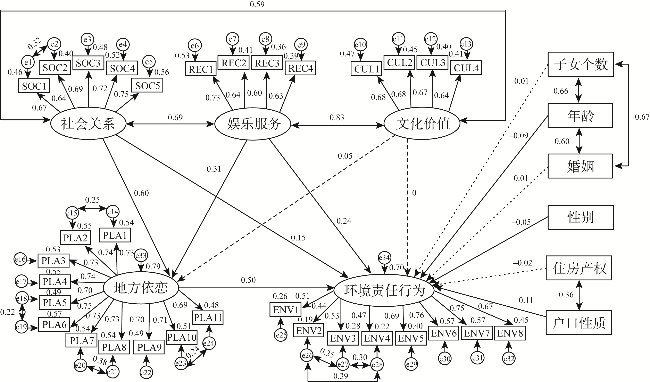
图4 模型标准化参数估计路径注:e1, e2, …, e34为残差(error),矩形框为测量变量,椭圆框为潜变量,测量变量与潜变量之间的数值为因子负荷,潜变量与潜变量之间的数值为回归系数,测量变量和潜变量上方的数值表示多元相关平方(Squared Multiple Correlations),两个残差之间、两个变量之间有数值说明其间存在相关。实线表示影响显著,虚线表示影响不显著;SOC1~SOC5、REC1~REC4、CUL1~CUL5、PLA1~PLA11、ENV1~ENV8含义见表1。 Fig. 4 Standardized parameter estimation and path diagram of the model |
表5 假设检验结果Table 5 Results of hypothesis test |
| 假设 | 路径 | 标准化路径系数β | P值 | 结果 |
|---|---|---|---|---|
| H1 | SOC→PLA | 0.602*** | 0.000 | 支持 |
| H2 | REC→PLA | 0.315*** | 0.000 | 支持 |
| H3 | CUL→PLA | 0.050 | 0.375 | 不支持 |
| H4 | SOC→ENV | 0.146* | 0.011 | 支持 |
| H5 | REC→ENV | 0.237** | 0.002 | 支持 |
| H6 | CUL→ENV | -0.002 | 0.971 | 不支持 |
| H7 | PLA→ENV | 0.499*** | 0.000 | 支持 |
注:∗∗、∗分别表示P<0.01、P<0.05。 |
表6 中介效应检验结果Table 6 Results of mediating effect test |
| 效应 | 路径 | 标准化系数 | 95%置信区间 |
|---|---|---|---|
| 间接效应 | SOC→PLA→ENV | 0.300 | [0.205, 0.415] |
| 直接效应 | SOC→ENV | 0.146 | [0.003, 0.269] |
| 总效应 | SOC→ENV | 0.446 | [0.351, 0.535] |
| 间接效应 | REC→PLA→ENV | 0.157 | [0.087, 0.248] |
| 直接效应 | REC→ENV | 0.237 | [0.070, 0.428] |
| 总效应 | SOC→ENV | 0.394 | [0.231, 0.597] |
| [1] |
|
| [2] |
汪鑫, 张宇翔, 赵俊威, 等. 城市公园生态系统文化服务感知满意度评价与提升策略: 以成都市成华区为例. 城市发展研究, 2024, 31(11): 120-127.
[
|
| [3] |
|
| [4] |
|
| [5] |
董连耕, 朱文博, 高阳, 等. 生态系统文化服务研究进展. 北京大学学报: 自然科学版, 2014, 50(6): 1155-1162.
[
|
| [6] |
钟敬秋, 高梦凡, 韩增林, 等. 基于生态系统文化服务的人地关系空间重构. 地理学报, 2024, 79(7): 1682-1699.
[
|
| [7] |
|
| [8] |
|
| [9] |
|
| [10] |
|
| [11] |
朱竑, 刘博. 地方感、地方依恋与地方认同等概念的辨析及研究启示. 华南师范大学学报: 自然科学版, 2011, 43(1): 1-8.
[
|
| [12] |
|
| [13] |
|
| [14] |
|
| [15] |
|
| [16] |
陈一凡, 陈爽. 绿地感知质量对“老漂族”社区归属感的作用机制: 基于南京典型住区的实证研究. 生态与农村环境学报, 2025, 41(5): 626-638.
[
|
| [17] |
陈晔, 曹智辉, 易柳夙, 等. 目的地依恋研究述评: 理论框架与研究展望. 旅游学刊, 2024, 39(8): 112-126.
[
|
| [18] |
|
| [19] |
王玉明. 广州大规模迁移砍伐城市树木事件的过程追踪. 哈尔滨工业大学学报: 社会科学版, 2023, 25(5): 118-27.
[
|
| [20] |
罗琦, 甄霖, 杨婉妮, 等. 生态治理工程对锡林郭勒草地生态系统文化服务感知的影响研究. 自然资源学报, 2020, 35(1): 119-129.
[
|
| [21] |
Millennium Ecosystem Assessment. Ecosystems and Human Well-being. Washington D C: Island Press, 2005: 77-101.
|
| [22] |
|
| [23] |
郭宇, 张敏. 文化生态系统服务评估在国土空间规划中的应用展望. 自然资源学报, 2024, 39(2): 319-335.
[
|
| [24] |
张军谋, 左兰, 刘海军, 等. 基于游客感知的沙漠旅游景区生态系统文化服务价值评估: 以图开沙漠旅游景区为例. 生态学报, 2025, 45(12): 5710-5722.
[
|
| [25] |
|
| [26] |
|
| [27] |
|
| [28] |
|
| [29] |
|
| [30] |
|
| [31] |
|
| [32] |
|
| [33] |
|
| [34] |
|
| [35] |
|
| [36] |
洪学婷, 张宏梅. 国外环境责任行为研究进展及对中国的启示. 地理科学进展, 2016, 35(12): 1459-1471.
[
|
| [37] |
|
| [38] |
|
| [39] |
|
| [40] |
|
| [41] |
|
| [42] |
吴建兴, 吴茂英, 郭英之, 等. 旅游地居民环境责任行为研究进展与展望. 旅游学刊, 2023, 38(11): 140-152.
[
|
| [43] |
|
| [44] |
|
| [45] |
祁潇潇, 赵亮, 胡迎春. 敬畏情绪对旅游者实施环境责任行为的影响: 以地方依恋为中介. 旅游学刊, 2018, 33(11): 110-121.
[
|
| [46] |
段正梁, 彭振, 贺小荣. 旅游者生态价值观对其环境责任行为的影响: 以岳麓山风景区为例. 地域研究与开发, 2021, 40(1): 132-137, 167.
[
|
| [47] |
|
| [48] |
|
| [49] |
|
| [50] |
|
| [51] |
|
| [52] |
|
| [53] |
|
| [54] |
|
| [55] |
谢涤湘, 谢晓亮, 兰妍, 等. 老年人的休闲涉入与地方依恋: 基于广州城市公园的实证研究. 地理科学, 2022, 42(4): 692-701.
[
|
| [56] |
|
| [57] |
|
| [58] |
|
| [59] |
|
| [60] |
谢涤湘, 谭俊杰, 常江. 广州市老城区老年人及青壮年的社区依恋异同研究. 城市发展研究, 2019, 26(5): 16-21.
[
|
| [61] |
|
| [62] |
|
| [63] |
|
| [64] |
杨良健, 章锦河, 马小宾, 等. 生态系统文化服务价值感知量表研究: 基于国家公园游客视角. 生态学报, 2025, 45(11): 5310-5321.
[
|
| [65] |
|
| [66] |
赵雨晴, 游巍斌, 林雪儿, 等. 游客和居民视角下武夷山市生态系统文化服务感知比较研究. 生态学报, 2022, 42(10): 4011-22.
[
|
| [67] |
李洋洋, 赵振斌, 李小永, 等. 老家依恋对秦巴山区生态移民新环境融入的影响: 基于陕南三市的案例研究. 自然资源学报, 2021, 36(10): 2541-2556.
[
|
/
| 〈 |
|
〉 |