JOURNAL OF NATURAL RESOURCES >
The conceptual connotation and key issues of the key zone of land-sea integration: Based on the perspective of coastal human settlement environment system research
Received date: 2024-11-11
Revised date: 2025-08-09
Online published: 2025-10-31
Land-sea integration is the core value orientation for the synergistic utilization of terrestrial and marine space and resources in China. To construct a coastal human settlement environment system featuring human-land (sea) interaction under the multidimensional goals of land-sea integration, this paper proposes the concept of the "Key Zone of Land-Sea Integration" and its spatial structure of "supporting zone-core zone-associated zone-hinterland zone". The Key Zone of Land-Sea Integration implements the research perspective of the coastal human settlement environment system in terms of scope definition, hierarchical structure, research priorities, and development dimensions. It follows the research approach of "spatial structure-geomorphic pattern-ecological network-human settlement order", couples the multidimensional values of "ecology-economy-space-culture-society", and puts forward key research issues. Specifically, in scope definition, it clarifies the spatial scope integrating land and sea, covering both coastal areas and their adjacent terrestrial and marine extensions. In hierarchical structure, it establishes a multi-level system to adapt to analyses and management at different scales. In research priorities, it focuses on the dynamic interactions between human activities and the natural environment within the zone. In development dimensions, it emphasizes the balance among economic growth, social progress, and ecological protection. Focusing on the integration of human-land (sea) interaction and the integration of land-sea multidimensional values at the urban scale from the perspective of the coastal human settlement system environment, the Key Zone of Land-Sea Coordination proposes clear spatial objects and carriers. It will further promote the integration of land-sea coordinated territorial spatial planning and governance, break down traditional barriers between land and sea management, and facilitate high-quality development of coastal human settlement by guiding rational spatial layout, efficient resource utilization, and harmonious coexistence between human and nature. Thus, it provides theoretical support and practical guidance for advancing systematic management of coastal areas and optimizing the sustainable development pattern of coastal human settlement.
ZENG Peng , SHENG Xin-lei , CAI Liang-wa , XIE Yong-qing , LI Jin-xuan , WEI Chen-peng . The conceptual connotation and key issues of the key zone of land-sea integration: Based on the perspective of coastal human settlement environment system research[J]. JOURNAL OF NATURAL RESOURCES, 2025 , 40(11) : 2920 -2934 . DOI: 10.31497/zrzyxb.20251103
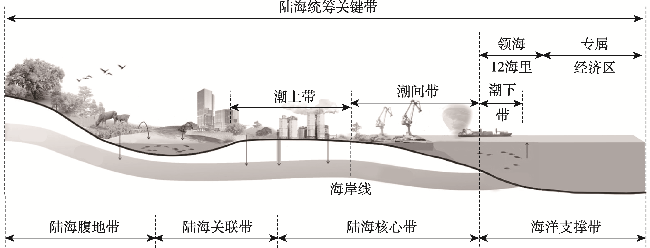
图4 陆海统筹关键带结构概念示意注:根据文献 [29] 底图改绘。 Fig. 4 The schematic diagram of the structural concept of the key zone of land-sea integration |
表1 陆海统筹关键带的划分、要素、问题与风险Table 1 The categorization, elements, challenges and risks of the key zone of land-sea integration |
| 海洋支撑带 | 陆海核心带 | 陆海关联带 | 陆海腹地带 | |
|---|---|---|---|---|
| 范围 | 海洋生态系统和海洋资源利用的重要海域地带 | 陆海系统物质、能量的直接交换地带 | 陆海系统直接影响地带,受海洋气候、灾害直接影响,并对海洋产生直接影响的陆域 | 受海洋气候影响,经济社会发展对海洋有一定依赖性,并对海洋生态环境存在潜在影响的陆域 |
| 要素 | 自然:鱼类的索饵场、育幼场、产卵场、洄游通道等 人工:钻井平台、水利设施等 | 自然:滨海平原、河口湿地、三角洲等 人工:港口码头、滨海旅游区等 | 自然:盐碱地区、湿地 人工:滨海城市、滨海产业区等 | 自然:山水林田湖草沙 人工:城镇村、产业空间等 |
| 问题 风险 | 海洋运输、海洋污染等 | 沿海风暴、围海造地、用海工程建设、海水养殖等 | 生活排污、工业废水、化石燃料焚烧、超采地下水、海水倒灌等 | 地表地下径流、动物迁徙、植被破坏、城乡无序建设、垃圾倾倒、河湖生态恶化等 |
| [1] |
韩立民, 卢宁. 关于海陆一体化的理论思考. 太平洋学报, 2007, 15(8): 82-87.
[
|
| [2] |
张海峰. 海陆统筹兴海强国: 实施海陆统筹战略, 树立科学的能源观. 太平洋学报, 2005, 13(3): 27-33.
[
|
| [3] |
高之国. 深化研究海洋发展战略努力推进海洋强国建设. 海洋开发与管理, 2012, 29(2): 62-64.
[
|
| [4] |
文超祥, 阙权鸿, 林小如. 基于海湾单元的陆海统筹空间规划研究. 城市发展研究, 2022, 29(1): 27-34.
[
|
| [5] |
吴志峰, 胡伟平. 海岸带与地球系统科学研究. 地理科学进展, 1999, 18(4): 346-351.
[
|
| [6] |
文超祥, 刘健枭. 基于陆海统筹的海岸带空间规划研究综述与展望. 规划师, 2019, 35(7): 5-11.
[
|
| [7] |
鲍捷, 吴殿廷. 空间、尺度与系统: 中国海陆统筹发展战略的地理学研究. 南京: 东南大学出版社, 2016: 46-47.
[
|
| [8] |
栾维新, 王辉, 片峰, 等. 中国陆海统筹战略研究. 北京: 科学出版社, 2016: 25-39.
[
|
| [9] |
张永战, 王颖. 海岸海洋科学研究新进展. 地理学报, 2006, 61(4): 446.
[
|
| [10] |
贾建军, 于谦, 高抒. 海岸分类的回顾与展望. 海洋通报, 2023, 42(6): 601-616.
[
|
| [11] |
|
| [12] |
孙晶, 刘建国, 杨新军, 等. 人类世可持续发展背景下的远程耦合框架及其应用. 地理学报, 2020, 75(11): 2408-2416.
[
|
| [13] |
吴传钧. 论地理学的研究核心: 人地关系地域系统. 经济地理, 1991, 11(3): 1-6.
[
|
| [14] |
曹小曙. 人类关键区的科学逻辑与研究趋势. 地理科学, 2022, 42(1): 31-42.
[
|
| [15] |
杨蓉, 袁振杰, 尹铎, 等. 人地互动关键带的内涵与理论框架探索. 地理学报, 2023, 78(11): 2659-2675.
[
|
| [16] |
张耀光. 从人地关系地域系统到人海关系地域系统: 吴传均院士对中国海洋地理学的贡献. 地理科学, 2008, 28(1): 6-9.
[
|
| [17] |
刘天宝, 韩增林, 彭飞. 人海关系地域系统的构成及其研究重点探讨. 地理科学, 2017, 37(10): 1527-1534.
[
|
| [18] |
刘天宝, 杨芳芳, 韩增林, 等. 人海关系地域系统视角下海洋本体的解构与研究重点. 地理科学, 2019, 39(8): 1321-1329.
[
|
| [19] |
胡素清. 以人海关系为核心的海洋观. 浙江学刊, 2015, (1): 131-134.
[
|
| [20] |
刘永超, 张海涛, 应超, 等. 人地复合生态系统韧性研究进展及其对海岸带生态系统韧性研究的启示. 海洋通报, 2024, 43(3): 415-425.
[
|
| [21] |
李博, 史钊源, 韩增林, 等. 环渤海地区人海经济系统环境适应性时空差异及影响因素. 地理学报, 2018, 73(6): 1121-1132.
[
|
| [22] |
|
| [23] |
|
| [24] |
|
| [25] |
|
| [26] |
吴良镛. 人居环境科学导论. 北京: 中国建筑工业出版社, 2001: 37-84.
[
|
| [27] |
|
| [28] |
李小云, 杨宇, 刘毅. 中国人地关系演进及其资源环境基础研究进展. 地理学报, 2016, 71(12): 2067-2088.
[
|
| [29] |
|
| [30] |
陆铭, 向宽虎, 李鹏飞, 等. 分工与协调: 区域发展的新格局、新理论与新路径. 中国工业经济, 2023, (8): 5-22.
[
|
| [31] |
王丽丽. 海岸带空间规划编制陆海统筹的关键技术探索. 现代城市研究, 2022, 37(7): 35-41.
[
|
| [32] |
张超, 刘蓓蓓, 李楠, 等. 面向可持续发展的资源关联研究: 现状与展望. 科学通报, 2021, 66(26): 3426-3440.
[
|
| [33] |
章海波, 骆永明, 刘兴华, 等. 海岸带蓝碳研究及其展望. 中国科学: 地球科学, 2015, 45(11): 1641-1648.
[
|
| [34] |
盖美, 岳鹏, 徐晶晶, 等. 基于人地系统视角的海岸带韧性解构与测度. 地理研究, 2023, 42(10): 2605-2621.
[
|
| [35] |
鲍海君, 曹伟, 叶扬, 等. 数据驱动的国土空间规划: 理论、范式及趋势. 中国土地科学, 2024, 38(1): 53-63.
[
|
| [36] |
陈炜, 刘西宁, 蔡梦雅, 等. 陆海一体化基础地理信息产品研制关键技术. 海洋测绘, 2023, 43(3): 78-82.
[
|
| [37] |
李加林, 田鹏, 李昌达, 等. 基于陆海统筹的陆海经济关系及国土空间利用: 现状、问题及发展方向. 自然资源学报, 2022, 37(4): 924-941.
[
|
| [38] |
李加林, 沈满洪, 马仁锋, 等. 海洋生态文明建设背景下的海洋资源经济与海洋战略. 自然资源学报, 2022, 37(4): 829-849.
[
|
| [39] |
林小如, 徐铭晖, 文超祥, 等. 基于多尺度协调视角的省级海岸带产业空间陆海统筹规划理论与方法: 以福建省为例. 城市规划学刊, 2024, (4): 112-118.
[
|
| [40] |
|
| [41] |
李彦平, 刘大海, 陈逸洋, 等. 海域三维空间资源认知与立体化管理. 自然资源学报, 2024, 39(1): 49-61.
[
|
| [42] |
程遥, 王启轩. 国土空间规划体系下的国土空间开发绩效评价: 框架建构与关键议题. 自然资源学报, 2024, 39(2): 274-286.
[
|
| [43] |
曾鹏, 魏琛朋, 蔡良娃. 海湾及沿海都市圈格局下的新城建设与发展模式: 渤海湾与长三角核心区的对比分析. 上海城市规划, 2022, (3): 75-80.
[
|
| [44] |
狄乾斌, 计利群. 地域认同视角下沿海城市海洋性特征分析与评价. 地理科学, 2016, 36(11): 1688-1696.
[
|
| [45] |
李瑞, 吴殿廷, 朱桃杏, 等. 基于内涵界定的我国滨海旅游发展模式研究. 热带地理, 2012, 32(5): 527-536.
[
|
| [46] |
肖若兰, 马仁锋, 马静武, 等. 全球海洋中心城市: 理论溯源、衡量基线与方法论争. 世界地理研究, 2024, 33(9): 104-117.
[
|
| [47] |
孙悦民. 海洋治理概念内涵的演化研究. 广东海洋大学学报, 2015, 35(2): 1-5.
[
|
| [48] |
王启轩, 任婕. 我国流域国土空间规划制度构建的若干探讨: 基于国际经验的启示. 城市规划, 2021, 45(2): 65-72.
[
|
| [49] |
孙施文. 国土空间规划实施监督体系的基础研究. 城市规划学刊, 2024, (2): 12-17.
[
|
| [50] |
陈伟光, 韩雪莹, 唐丹玲. 全球海洋治理: 一种类型学的分析框架. 学术研究, 2023, (5): 62-68, 187.
[
|
/
| 〈 |
|
〉 |