JOURNAL OF NATURAL RESOURCES >
A study on the intention of indigenous residents to support the construction of national parks: Take Hainan Tropical Rainforest National Park as an example
Received date: 2022-10-08
Revised date: 2023-01-08
Online published: 2023-06-09
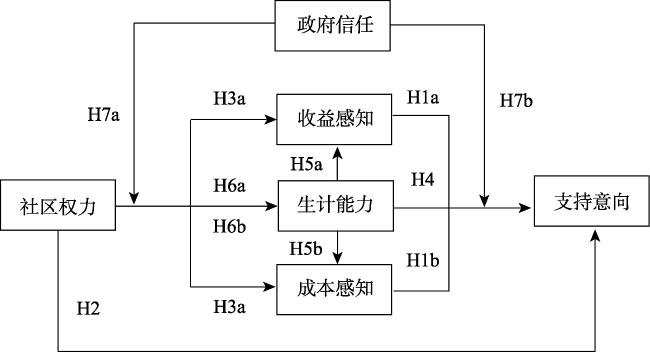
Aboriginal people are an important part of national park ecology. It is crucially important for the sustainable development of national parks to deeply reveal the formation mechanism of aboriginal people's intention to support the construction of national parks. Taking Diaoluoshan area of Hainan Tropical Rainforest National Park as an example, this paper empirically investigates the benefit perception and cost perception of aborigines on the impact of national park construction, discusses the relationship between community power and support intention, and further analyzes the regulatory role of government trust and the intermediary role of livelihood capacity. The results show that community power has a positive impact on aboriginal benefit perception and a negative impact on cost perception. Benefit perception has a significant positive impact on support intention, while there is no significant correlation between cost perception and support intention. The effect of livelihood capacity on support intention is both direct and indirect through benefit perception. Government trust has a significant moderating effect on the relationship between impact perception, livelihood ability and support intention. Government trust has a positive regulatory effect on the relationship between benefit perception and support intention, and has no significant regulatory effect on the negative relationship between cost perception and support intention.
LI Feng , SHI Ben-lin . A study on the intention of indigenous residents to support the construction of national parks: Take Hainan Tropical Rainforest National Park as an example[J]. JOURNAL OF NATURAL RESOURCES, 2023 , 38(6) : 1602 -1617 . DOI: 10.31497/zrzyxb.20230614
表1 信度与收敛效度检验Table 1 Test of reliability and convergent validity |
| 变量 | 测量题项 | 因子载荷 | t值 | 均值 | 标准差 | Cronbach's α | 组合信度 | AVE |
|---|---|---|---|---|---|---|---|---|
| CP | CP1 | 0.854 | — | 4.21 | 0.817 | 0.776 | 0.896 | 0.685 |
| CP2 | 0.863 | 21.441 | 4.02 | 0.768 | ||||
| CP3 | 0.836 | 18.167 | 4.18 | 0.823 | ||||
| CP4 | 0.628 | 14.023 | 4.05 | 0.968 | ||||
| PB | PB1 | 0.810 | — | 4.12 | 0.914 | 0.714 | 0.833 | 0.713 |
| PB2 | 0.718 | 14.562 | 3.27 | |||||
| PB3 | 0.821 | 10.269 | 4.22 | |||||
| PB4 | 0.826 | 11.784 | 4.15 | 0.855 | ||||
| PC | PC1 | 0.744 | — | 2.17 | 1.231 | 0.662 | 0.742 | 0.532 |
| PC2 | 0.719 | 8.717 | 1.68 | 1.051 | ||||
| PC3 | 0.678 | 7.653 | 1.41 | 0.868 | ||||
| PC4 | 0.711 | 8.417 | 2.14 | 0.963 | ||||
| PC5 | 0.608 | 9.101 | 2.42 | 1.424 | ||||
| LL | LL1 | 0.937 | — | 2.84 | 1.567 | 0.761 | 0.887 | 0.672 |
| LL2 | 0.729 | 31.427 | 2.71 | 1.519 | ||||
| LL3 | 0.644 | 14.874 | 3.26 | 1.178 | ||||
| GT | GT1 | 0.639 | — | 4.35 | 0.614 | 0.801 | 0.837 | 0.564 |
| GT2 | 0.718 | 11.452 | 4.43 | 0.603 | ||||
| GT3 | 0.626 | 11.786 | 4.27 | 0.731 | ||||
| GT4 | 0.787 | 11.656 | 4.36 | 0.638 | ||||
| SD | SD1 | 0.779 | — | 4.17 | 0.778 | 0.835 | 0.895 | 0.689 |
| SD2 | 0.843 | 17.781 | 4.28 | 0.732 | ||||
| SD3 | 0.668 | 12.896 | 4.24 | 0.814 | ||||
| SD4 | 0.575 | 13.451 | 4.15 | 0.764 |
表2 模型拟合度和因子区别效度检验Table 2 Test of confirmatory model fit and factor discriminant validity |
| 模型 | x2/df | GFI | IFI | TLI | CFI | RMSEA | PGFI |
|---|---|---|---|---|---|---|---|
| M6(P、F、C、L、T、S) | 2.669 | 0.884 | 0.908 | 0.911 | 0.913 | 0.062 | 0.774 |
| M5a(P、F、C、L+T、S) | 2.996 | 0.866 | 0.901 | 0.887 | 0.900 | 0.066 | 0.657 |
| M5b(P、F、C、L+S、T) | 3.013 | 0.867 | 0.898 | 0.879 | 0.897 | 0.061 | 0.701 |
| M4(P、F、C、L+T+S) | 3.172 | 0.848 | 0.887 | 0.872 | 0.886 | 0.071 | 0.633 |
| M3a(P、F+L+T+S、C) | 3.202 | 0.825 | 0.902 | 0.886 | 0.901 | 0.064 | 0.567 |
| M3b(P、C+L+T+S、F) | 3.317 | 0.871 | 0.846 | 0.901 | 0.885 | 0.070 | 0.671 |
| M2a(P+L+T+S+F、C) | 3.541 | 0.862 | 0.845 | 0.883 | 0.812 | 0.072 | 0.524 |
| M2b(P+L+T+S+C、F) | 3.701 | 0.859 | 0.873 | 0. 876 | 0.871 | 0.073 | 0.665 |
| M1(P+L+T+S+C+F) | 4.126 | 0. 834 | 0.839 | 0. 822 | 0.834 | 0.084 | 0.576 |
注:Mn代表n因子模型,P表示社区权力,F表示收益感知,C表示成本感知,L表示生计能力,T表示政府信任,S表示支持意向。 |
表3 路径分析及假设验证结果Table 3 The path analysis and hypothesis verification results |
| 假设关系 | 路径关系 | 路径系数 | t值 | SE | 检验假设结果 | ||
|---|---|---|---|---|---|---|---|
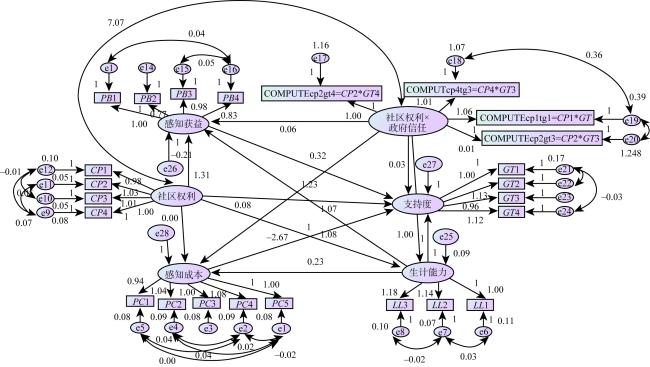
| H1a | 支持度 | ← | 收益感知 | 0.217 | 3.011** | 0.042 | H1a支持 |
| H1b | 支持度 | ← | 成本感知 | -0.028 | -0.470 | 0.037 | H1b拒绝 |
| H2 | 支持度 | ← | 社区权力 | 0.236 | 3.142** | 0.033 | H1支持 |
| H3a | 收益感知 | ← | 社区权力 | 0.226 | 3.171** | 0.051 | H3a支持 |
| H3b | 成本感知 | ← | 社区权力 | 0.131 | 2.426** | 0.024 | H3b支持 |
| H4 | 支持度 | ← | 生计能力 | 0.234 | 3.271** | 0.040 | H4支持 |
| H5a | 收益感知 | ← | 生计能力 | 0.377 | 5.226*** | 0.054 | H5a支持 |
| H5b | 成本感知 | ← | 生计能力 | -0.138 | 2.185* | 0.069 | H5b拒绝 |
注:*表示P<0.05,**表示P<0.01,***表示P<0.001,下同。 |
表4 社区权力与支持意向之间多重中介效应Table 4 Effects of multiple mediators between community power and support intentions |
| 效应类型 | B | Boot 标准误差 | Boot95%置信区间 | 相对效应/% | |
|---|---|---|---|---|---|
| 上限 | 下限 | ||||
| 总效应 | 0.264 | 0.039 | 0.215 | 0.346 | |
| 直接效应 | 0.162 | 0.044 | 0.034 | 0.131 | 64.76 |
| 间接效应 | 0.102 | 0.027 | 0.047 | 0.135 | 35.24 |
| 社区权力→生计能力→支持意向 | 0.048 | 0.021 | 0.021 | 0.069 | |
| 社区权力→成本感知→支持意向 | 0.001 | 0.005 | -0.009 | 0.014 | |
| 社区权力→收益感知→支持意向 | 0.028 | 0.013 | 0.003 | 0.058 | |
| 社区权力→收益感知→生计能力→支持意向 | 0.017 | 0.058 | 0.021 | 0.032 | |
| 社区权力→成本感知→生计能力→支持意向 | 0.000 | 0.003 | -0.028 | 0.002 | |
注:根据AMOS 22.0所呈现出来的文本结果整理而得。 |
表5 调节效应检验结果Table 5 Test results of moderating effect |
| 项目 | 变量 | 支持意向 | |||||
|---|---|---|---|---|---|---|---|
| M1 | M2 | M3 | M4 | M5 | M6 | ||
| 控制变量 | 性别 | 0.039 | 0.028 | 0.034 | 0.041 | 0.042 | 0.033 |
| 年龄 | -0.092* | -0.164*** | -0.215*** | -0.202*** | -0.202*** | -0.116*** | |
| 文化程度 | 0.077 | 0.008 | -0.021 | -0.014 | -0.021 | -0.029 | |
| 收入来源 | -0.019 | 0.046 | 0.063 | 0.047 | 0.048 | 0.036 | |
| 年收入 | 0.164** | 0.142** | 0.159** | 0.128*** | 0.126*** | 0.152** | |
| 自变量 | 社区权力(SP) | 0.337** | 0.376** | 0.407** | 0.273** | 0.297** | |
| 收益感知(PF) | 0.320** | 0.187*** | 0.365** | ||||
| 成本感知(PC) | -0.257*** | -0.288*** | -0.274*** | ||||
| 调节变量 | 政府信任(GT) | 0.402*** | 0.508*** | 0.418*** | 0.512*** | 0.334*** | |
| 乘积项 | SP×PF×GT | -0.046*** | -0.036*** | ||||
| SP×PC×GT | 0.081* | 0.097* | |||||
| F值 | 2.973** | 40.117*** | 30.116*** | 31.217*** | 23.778*** | 45.178*** | |
| R2 | 0.042 | 0.418 | 0.328 | 0.289 | 0.302 | 0.347 | |
| △F值 | 2.875** | 98.876*** | 88.044*** | 0.015 | 64.116* | 7.029* | |
| △R2 | 0.041 | 0.288 | 0.276 | 0.000 | 0.058 | 0.016 | |
| [1] |
习近平. 决胜全面建成小康社会夺取新时代中国特色社会主义伟大胜利. 人民日报, 2017-10-28(001).
[
|
| [2] |
章锦河, 苏杨, 钟林生, 等. 国家公园科学保护与生态旅游高质量发展: 理论思考与创新实践. 中国生态旅游, 2022, 12(2): 189-207.
[
|
| [3] |
杨金娜, 尚琴琴, 张玉钧. 我国国家公园建设的社区参与机制研究. 世界林业研究, 2018, 31(4): 76-80.
[
|
| [4] |
|
| [5] |
王咏, 陆林. 基于社会交换理论的社区旅游支持度模型及应用. 地理学报, 2014, 69(10): 1557-1574.
[
|
| [6] |
|
| [7] |
|
| [8] |
方言, 吴静. 中国国家公园的土地权属与人地关系研究. 旅游科学, 2017, 31(3): 14-23.
[
|
| [9] |
|
| [10] |
李志龙, 陈慧灵, 刘迪. 基于能值理论武陵山片区旅游生态化水平测度与空间异质性分析. 自然资源学报, 2021, 36(12): 3203-3214.
[
|
| [11] |
|
| [12] |
张书杰, 庄优波. 英国国家公园合作伙伴管理模式研究: 以苏格兰凯恩戈姆斯国家公园为例. 风景园林, 2019, 26(4): 28-32.
[
|
| [13] |
|
| [14] |
苏杨, 王蕾. 中国国家公园体制试点的相关概念、政策背景和技术难点. 环境保护, 2015, 43(14): 17-23.
[
|
| [15] |
|
| [16] |
蔡晓梅, 苏杨. 从冲突到共生—生态文明建设中国家公园的制度逻辑. 管理世界, 2022, 38(11): 131-154.
[
|
| [17] |
者荣娜, 刘华. 我国国家公园建设中社区权利新探. 世界林业研究, 2019, 32(5): 72-77.
[
|
| [18] |
|
| [19] |
魏钰, 何思源, 雷光春, 等. 保护地役权对中国国家公园统一管理的启示: 基于美国经验. 北京林业大学学报: 社会科学版, 2019, 18(1): 70-79.
[
|
| [20] |
|
| [21] |
于涵, 陈战是. 英国国家公园建设活动管控的经验与启示. 风景园林, 2018, 25(6): 96-100.
[
|
| [22] |
约翰·克莱顿·托马斯. 公共决策中的公民参与:公共管理者的新技能与新策略. 北京: 中国人民大学出版社, 2005: 162-170.
[
|
| [23] |
廖凌云. 武夷山国家公园体制试点区社区规划研究. 北京: 清华大学, 2018.
[
|
| [24] |
王宇飞, 苏红巧, 赵鑫蕊, 等. 基于保护地役权的自然保护地适应性管理方法探讨. 生物多样性, 2019, 27(1): 88-96.
[
|
| [25] |
|
| [26] |
CARNEY. Implementing a Sustainable Livelihood Approach. London: Department for International Development, 1998: 247-255.
|
| [27] |
赵雪雁. 地理学视角的可持续生计研究: 现状、问题与领域. 地理研究, 2017, 36(10): 1859-1872.
[
|
| [28] |
梁增贤, 黎结仪. 城市旅游非正规就业者生活质量感知研究: 以广州为例. 旅游学刊, 2015, 30(9): 72-81.
[
|
| [29] |
|
| [30] |
|
| [31] |
张引. 中国国家公园社区共管机制构建研究. 北京: 清华大学, 2020.
[
|
| [32] |
|
| [33] |
刘雨婧, 唐健雄. 中国旅游业绿色发展效率时空演变特征及影响机理. 自然资源学报, 2022, 37(3): 681-700.
[
|
| [34] |
|
| [35] |
杨锐. 试论世界国家公园运动的发展趋势. 中国园林, 2003, 19(7): 10-15.
[
|
| [36] |
高燕, 邓毅, 张浩. 境外国家公园社区管理冲突: 表现、溯源及启示. 旅游学刊, 2017, 32(1): 111-122.
[
|
| [37] |
赵翔, 朱子云, 吕植, 等. 社区为主体的保护: 对三江源国家公园生态管护公益岗位的思考. 生物多样性, 2018, 26(2): 210-216.
[
|
| [38] |
|
| [39] |
|
| [40] |
|
| [41] |
毕莹竹, 李丽娟, 张玉钧. 三江源国家公园利益相关者利益协调机制构建. 中国城市林业, 2019, 17(3): 35-39.
[
|
| [42] |
王旭辉, 高君陶. 嵌入性自主: 环境保护组织的社区合作逻辑及其限度. 中央民族大学学报: 哲学社会科学版, 2019, 46(4): 58-68.
[
|
| [43] |
肖练练, 钟林生, 虞虎, 等. 功能约束条件下的钱江源国家公园体制试点区游憩利用适宜性评价研究. 生态学报, 2019, 39(4): 1375-1384.
[
|
/
| 〈 |
|
〉 |