JOURNAL OF NATURAL RESOURCES >
Evaluation on the degree and potential of ecological restoration in Loess Plateau
Received date: 2022-01-04
Revised date: 2022-03-15
Online published: 2023-03-08
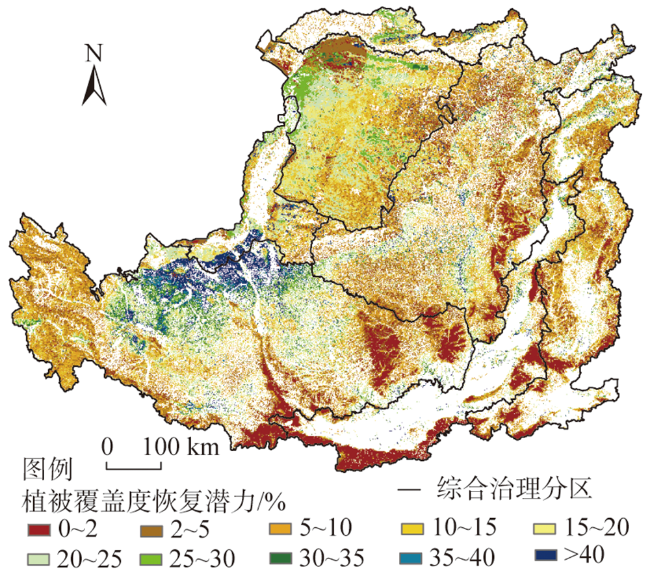
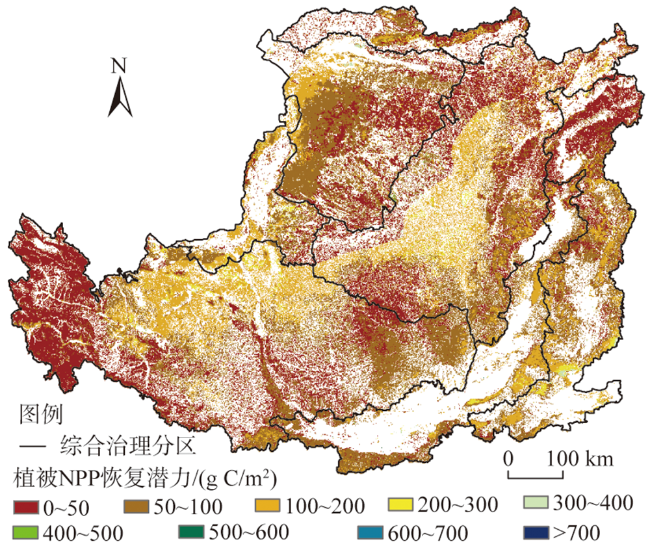
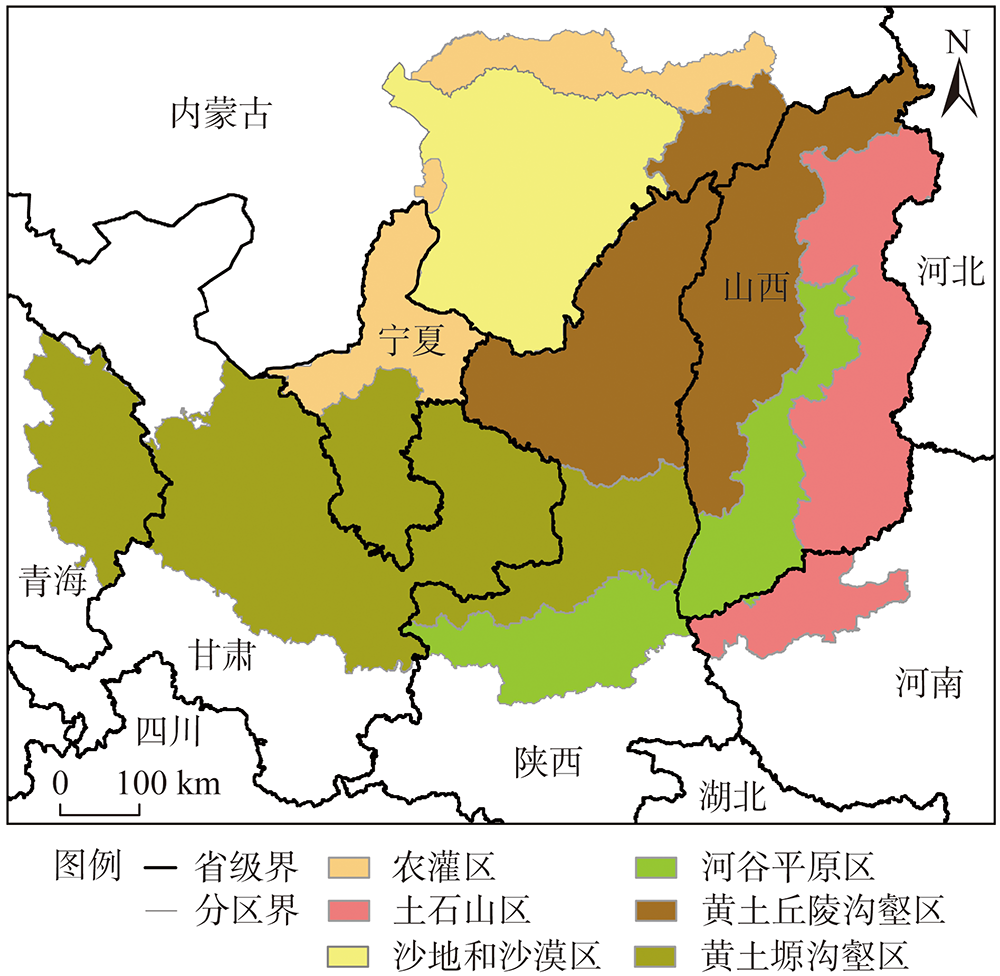
The Loess Plateau is the most fragile ecological environment and one of the most serious soil erosion areas in the world. China has implemented the Grain for Green Project and a series of ecological engineering in the Loess Plateau since 2000. They play a good role for ecosystem restoration. In order to assess the present situation, the ecological restoration degree and the ecological restoration potential in the Loess Plateau over the past 20 years, we selected ecological quality and ecosystem services to comprehensively analyze and evaluate the degree and potential of ecological restoration in this region from 2000 to 2019 by using ground and remote sensing monitoring data and model simulation. The results showed that: (1) The ecological quality was improved: Vegetation coverage and NPP showed an increasing trend. Compared with the changes from 2000 to 2009 and from 2010 to 2019, the proportion of the area with vegetation coverage and NPP continuously improved were 39.90% and 82.71%, respectively. (2) The ecosystem services improved: The areal proportion of water conservation service with continuous improvement was 15.46%, the areal proportion of soil conservation services first improved and then stabilized or first stabilized and then improved was 18.88%, the areal proportion of wind prevention and sand fixation service with continuous improvement was 6.30%. Water and soil conservation services were improved mainly in the farming-pastoral transitional zone of the gully region, while windbreak and sand-fixing service was improved mainly in the sandy and desert areas. (3) The areas with high degree of comprehensive ecological restoration accounted for 11.08%, which was mainly located in the gully region. Only a few non-restoration areas were mainly distributed in the northwest of the sandy land and desert region, accounting for 3.51%. (4) The restoration potential of vegetation coverage was 13.10%, the high value region was mainly located in the west of the gully region, and the low value region was mainly found in the southeast of the gully region and parts of the valley plain. The restoration potential of vegetation NPP is low on the whole, and the regions with greater potential are mainly located in the loess hilly-gully region.
NIU Li-nan , SHAO Quan-qin , NING Jia , YANG Xue-qing , LIU Shu-chao , LIU Guo-bo , ZHANG Xiong-yi , HUANG Hai-bo . Evaluation on the degree and potential of ecological restoration in Loess Plateau[J]. JOURNAL OF NATURAL RESOURCES, 2023 , 38(3) : 779 -794 . DOI: 10.31497/zrzyxb.20230314
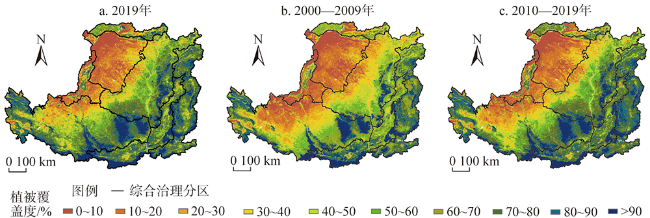
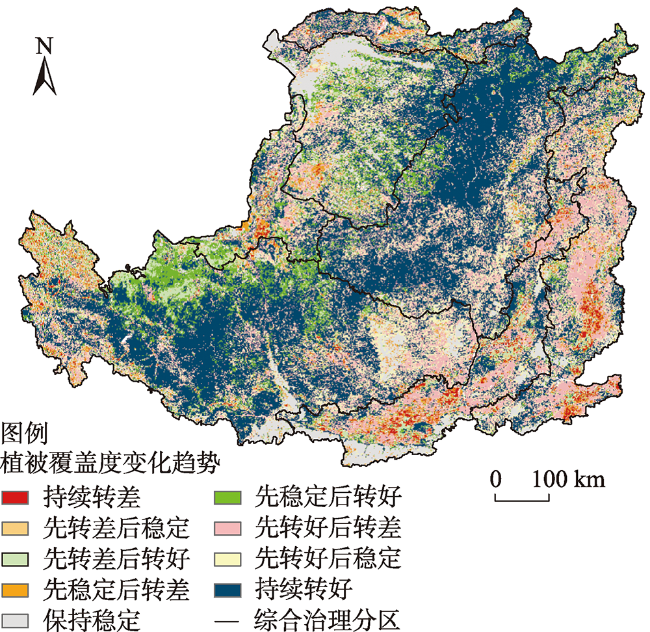
图2 2000—2019年黄土高原平均植被覆盖恢复状况Fig. 2 Average of restoration of vegetation coverage in the Loess Plateau from 2000 to 2019 |
表1 2000—2019年多年平均黄土高原植被覆盖度变化Table 1 Average annual value of restoration of vegetation coverage in the Loess Plateau from 2000 to 2019 (%) |
| 综合治理分区 | 2000—2009年 | 2010—2019年 | 变化率 |
|---|---|---|---|
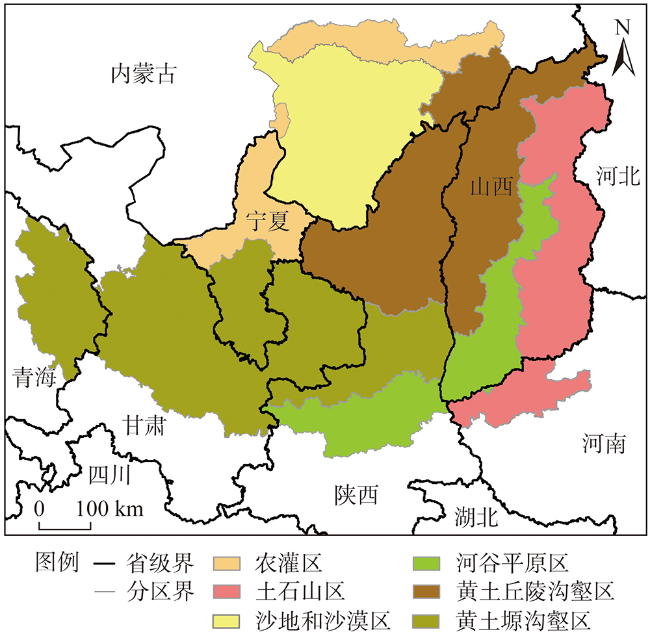
| 农灌区 | 30.76 | 34.84 | 4.08 |
| 沙地和沙漠区 | 14.95 | 17.45 | 2.50 |
| 黄土丘陵沟壑区 | 45.80 | 55.57 | 9.77 |
| 土石山区 | 73.68 | 76.94 | 3.26 |
| 黄土塬沟壑区 | 50.29 | 56.17 | 5.88 |
| 河谷平原区 | 72.79 | 74.81 | 2.02 |
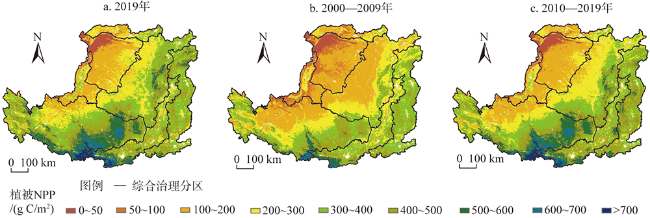
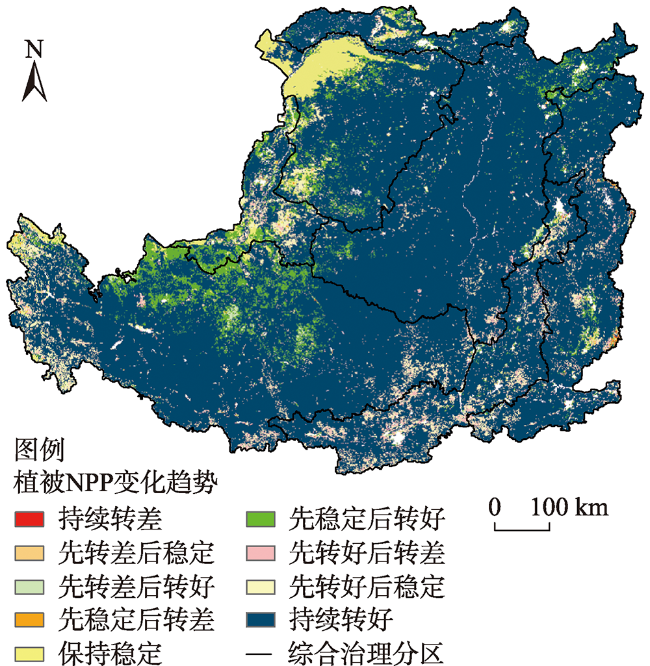
图4 2000—2009年黄土高原平均植被NPP恢复状况Fig. 4 Average restoration of vegetation NPP in the Loess Plateau from 2000 to 2019 |
表2 2000—2019年黄土高原平均植被NPP变化Table 2 Average annual value of restoration of vegetation NPP in the Loess Plateau from 2000 to 2019 |
| 综合治理分区 | 2000—2009年/(g C/m2) | 2010—2019年/(g C/m2) | 变化率/% |
|---|---|---|---|
| 农灌区 | 146.98 | 183.12 | 24.59 |
| 沙地和沙漠区 | 102.62 | 136.81 | 33.32 |
| 黄土丘陵沟壑区 | 222.64 | 315.34 | 41.64 |
| 土石山区 | 351.44 | 405.07 | 15.26 |
| 黄土塬沟壑区 | 294.65 | 372.58 | 26.45 |
| 河谷平原区 | 357.43 | 432.86 | 21.10 |
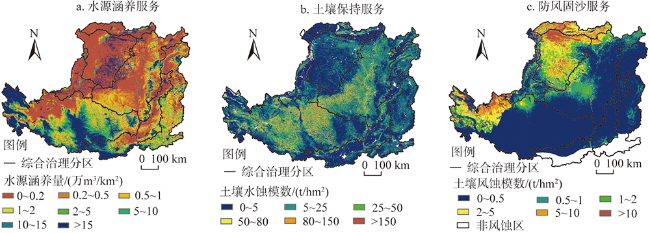
表3 2019年黄土高原生态系统服务量Table 3 Ecosystem services in the Loess Plateau in 2019 |
| 黄土高原治理分区 | 单位面积水源涵养量 /(万m3/km2) | 土壤水蚀模数 /(t/hm2) | 土壤风蚀模数 /(t/hm2) |
|---|---|---|---|
| 农灌区 | 172.14 | 7.82 | 3.86 |
| 河谷平原区 | 582.55 | 6.46 | 0.15 |
| 黄土塬沟壑区 | 447.35 | 20.58 | 1.31 |
| 土石山区 | 251.17 | 7.24 | 0.18 |
| 黄土丘陵沟壑区 | 165.47 | 17.40 | 0.64 |
| 沙地和沙漠区 | 232.03 | 4.39 | 4.42 |
图9 2000—2019年黄土高原生态恢复状况Fig. 9 Ecological restoration in the Loess Plateau from 2000 to 2019 |
表4 2000—2019年黄土高原生态恢复状况面积统计Table 4 Area statistics of ecological restoration in the Loess Plateau from 2000 to 2019 |
| 生态恢复状况 | 面积/万km2 | 面积占比/% |
|---|---|---|
| 无恢复 | 21859 | 3.51 |
| 恢复程度较低 | 112217 | 17.99 |
| 恢复程度中等 | 203076 | 32.57 |
| 恢复程度较高 | 217386 | 34.86 |
| 恢复成度高 | 69064 | 11.08 |
| [1] |
李洪远, 鞠美庭. 生态恢复的原理与实践. 北京: 化学工业出版社, 2004.
[
|
| [2] |
吴丹丹, 蔡运龙. 中国生态恢复效果评价研究综述. 地理科学进展, 2009, 28(4): 622-628.
[
|
| [3] |
|
| [4] |
|
| [5] |
董安涛, 史正涛, 苏旺德, 等. 南汀河流域生态恢复潜力评价. 生态经济, 2015, 31(10): 116-120.
[
|
| [6] |
|
| [7] |
|
| [8] |
|
| [9] |
|
| [10] |
于秀波. 我国生态退化、生态恢复及政策保障研究. 资源科学, 2002, 24(1): 72-76.
[
|
| [11] |
高江波, 赵志强, 李双成. 基于地理信息系统的青藏铁路穿越区生态系统恢复力评价. 应用生态学报, 2008, 19(11): 2473-2479.
[
|
| [12] |
张文辉, 刘国彬. 黄土高原植被恢复与建设策略. 中国水土保持, 2009, (1): 24-27.
[
|
| [13] |
孙泽兴, 李汶怡, 刘嘉敏, 等. 陕西省生态恢复综合效益评估. 生态学报, 2022, 42(7): 1-12.
[
|
| [14] |
吕振涛, 李生宇, 范敬龙, 等. 蒙古国植被自然恢复潜力. 中国沙漠, 2021, 41(5): 192-201.
[
|
| [15] |
张琨, 吕一河, 傅伯杰, 等. 黄土高原植被覆盖变化对生态系统服务影响及其阈值. 地理学报, 2020, 75(5): 949-960.
[
|
| [16] |
刘国彬, 上官周平, 姚文艺, 等. 黄土高原生态工程的生态成效. 中国科学院院刊, 2017, 32(1): 11-19.
[
|
| [17] |
国家发展改革委, 水利部, 农业部, 国家林业局. 黄土高原地区综合治理规划大纲(2010—2030年). http://www.gov.cn/zwgk/2011-01/17/content_1786454.htm, 2010-12-30.
[National Development and Reform Commission, Ministry of Water Resources, Ministry of Agriculture, State Forestry Administration. Planning Outline for Comprehensive Governance of the Loess Plateau Region (2010-2030). http://www.gov.cn/zwgk/2011-01/17/content_1786454.htm, 2010-12-30.]
|
| [18] |
|
| [19] |
申嘉澍, 李双成, 梁泽, 等. 生态系统服务供需关系研究进展与趋势展望. 自然资源学报, 2021, 36(8): 1909-1922.
[
|
| [20] |
柳冬青, 曹二佳, 张金茜, 等. 甘肃白龙江流域水源涵养服务时空格局及其影响因素. 自然资源学报, 2020, 35(7): 1728-1743.
[
|
| [21] |
|
| [22] |
|
| [23] |
周文佐, 刘高焕, 潘剑君. 土壤有效含水量的经验估算研究: 以东北黑土为例. 干旱区资源与环境, 2003, 17(4): 88-95.
[
|
| [24] |
刘家福, 蒋卫国, 占文凤, 等. SCS模型及其研究进展. 水土保持研究, 2010, 17(2): 120-124.
[
|
| [25] |
|
| [26] |
章文波, 谢云, 刘宝元. 利用日雨量计算降雨侵蚀力的方法研究. 地理科学, 2002, 22(6): 20-23.
[
|
| [27] |
|
| [28] |
|
| [29] |
蔡崇法, 丁树文, 史志华, 等. 应用USLE模型与地理信息IDRISI预测小流域土壤侵蚀量的研究. 水土保持学报, 2000, 14(2): 22-24.
[
|
| [30] |
巩国丽, 刘纪远, 邵全琴. 基于RWEQ的20世纪90年代以来内蒙古锡林郭勒盟土壤风蚀研究. 地理科学进展, 2014, 33(6): 825-834.
[
|
| [31] |
|
| [32] |
|
| [33] |
王佃来, 刘文萍, 黄心渊. 基于Sen+Mann-Kendall的北京植被变化趋势分析. 计算机工程与应用, 2013, 49(5): 13-17.
[
|
| [34] |
|
| [35] |
邵全琴, 刘树超, 宁佳, 等. 2000—2019年中国重大生态工程生态效益遥感评估. 地理学报, 2022, 77(9): 2133-2153.
[
|
| [36] |
赵一蕾, 黄文婕, 曹明, 等. 1961—2019年黄土高原植被潜在蒸散及影响因子. 环境科学研究, 2021, 34(9): 2208-2219.
[
|
| [37] |
|
| [38] |
汪晓珍, 吴建召, 吴普侠, 等. 2000—2015年黄土高原生态系统水源涵养、土壤保持和NPP服务的时空分布与权衡/协同关系. 水土保持学报, 2021, 35(4): 114-121, 128.
[
|
| [39] |
陈卓鑫, 王文龙, 郭明明, 等. 黄土高塬沟壑区植被恢复对不同地貌部位土壤可蚀性的影响. 自然资源学报, 2020, 35(2): 387-398.
[
|
| [40] |
刘旻霞, 赵瑞东, 邵鹏, 等. 近15 a黄土高原植被覆盖时空变化及驱动力分析. 干旱区地理, 2018, 41(1): 99-108.
[
|
| [41] |
杨磊, 冯青郁, 陈利顶. 黄土高原水土保持工程措施的生态系统服务. 资源科学, 2020, 42(1): 87-95.
[
|
| [42] |
李婷, 吕一河, 任艳姣, 等. 黄土高原植被恢复成效及影响因素. 生态学报, 2020, 40(23): 8593-8605.
[
|
| [43] |
高海东, 庞国伟, 李占斌, 等. 黄土高原植被恢复潜力研究. 地理学报, 2017, 72(5): 863-874.
[
|
| [44] |
赵广举, 穆兴民, 田鹏, 等. 黄土高原植被变化与恢复潜力预测. 水土保持学报, 2021, 35(1): 205-212.
[
|
| [45] |
潘梅, 陈天伟, 黄麟, 等. 京津冀地区生态系统服务时空变化及驱动因素. 生态学报, 2020, 40(15): 5151-5167.
[
|
| [46] |
|
| [47] |
|
/
| 〈 |
|
〉 |