Resource Evaluation

Research on meteorological drought in the middle and lower reaches of the Yangtze River

  • LI Ming , 1, 2, 3 ,
  • CHAI Xu-rong 1 ,
  • WANG Gui-wen , 1, ,
  • HU Wei-xia 4 ,
  • ZHANG Lian-zhi 1
Expand
  • 1. School of Geographical Sciences, Shanxi Normal University, Linfen 041000, Shanxi, China
  • 2. Modern College of Arts and Sciences, Shanxi Normal University, Linfen 041000, Shanxi, China
  • 3. Laboratory of Remote Sensing and Climate Information, Shanxi Normal University, Linfen 041000, Shanxi, China
  • 4. College of History and Tourism Culture, Shanxi Normal University, Linfen 041000, Shanxi, China

Received date: 2018-07-02

  Request revised date: 2018-11-20

  Online published: 2019-02-28

Copyright

《自然资源学报》编辑部 所有

Abstract

The middle and lower reaches of the Yangtze River serves as an important grain production base in China. In the context of global climate change, the drought events will directly affect the agriculture production and people's properties and lives in this region and also the national food security. In this study, the meteorological drought events have been extracted using run theory based on the standardized precipitation index (SPI), which is defined using the gridded dataset of monthly precipitation with a spatial resolution of 0.5°×0.5° in China from 1961 to 2015. The drought events are characterized by three variables including duration, severity and peak. Exponential and Gamma functions are then selected to describe the marginal distribution of drought duration and severity, respectively. The Clayton Copula is used to construct the joint distribution of drought duration and severity. Based on the above functions, conventional univariate frequency analysis and copula-based bivariate frequency analysis are used to characterize the spatial patterns of the drought events in the study area at various time scales over the past 55 years. While univariate analysis is focused on return levels of selected return periods (5-, 10-, 20-, and 30-year) for the SPI of 3-, 6-, and 12-month time scales, the bivariate analysis is focused on the joint occurrence probabilities P1 and P2 of drought duration and severity, where P1 is the probability of "drought duration and severity" exceeding their respective thresholds at the same time and P2 is the probability of "drought duration or severity" exceeding their respective thresholds at the same time. Here, the thresholds denote the duration and severity values corresponding to selected 5-, 10-, 20- and 30-year return periods. The results show that: (1) There are some differences between the spatial patterns of drought characteristics for the 3-month, 6-month, 12- month time scales in the middle and lower reaches of the Yangtze River, and the most serious droughts mainly occur in the lower reaches of the river. (2) Both drought duration and severity are positively correlated at various time scales, that is, the areas with higher drought severity are also associated with longer drought duration and vice versa. (3) Poyang Lake watershed and areas north of the lower Yangtze River are associated with larger values of the joint occurrence probability P1, that is, when the drought duration and severity exceed their corresponding 5, 10, 20 and 30-year return values at the same time, while smaller values of the joint occurrence probability P1 are noted for Southern Shaanxi, Southern Henan, a major portion of Hubei and central-north of Hunan, suggesting a low risk of droughts in these areas. The results of this study can provide theoretical basis for scientific managements of water resource and the risk assessments of drought disaster in the middle and lower reaches of the Yangtze River.

Cite this article

LI Ming , CHAI Xu-rong , WANG Gui-wen , HU Wei-xia , ZHANG Lian-zhi . Research on meteorological drought in the middle and lower reaches of the Yangtze River[J]. JOURNAL OF NATURAL RESOURCES, 2019 , 34(2) : 374 -384 . DOI: 10.31497/zrzyxb.20190213

干旱是指在某一时段内降水量持续少于多年平均的气象事件,它是暂时的、阶段性的气候现象,不同于干旱气候。干旱在世界大多数地方均可能发生,甚至湿润地区[1]。由于不同学科对干旱的理解不一致,目前还未形成统一的、严格的干旱定义。国际通用的干旱类型包括气象干旱、水文干旱、农业干旱和社会经济干旱。其中,气象干旱首先发生,其他干旱类型都是气象干旱发展的结果,故对气象干旱的监测可以为其他类型的干旱提前预警[1]。本文主要关注基于标准化降水指数(SPI)的气象干旱,该指数已被证明是监测和研究区域或全球干旱化过程的强有力工具[2,3,4]
长江中下游地区是中国重要的粮食生产基地,受季风影响显著,季风雨带的往返移动导致该区域经常发生伏旱或伏秋连旱。另外,由于该区域人口众多、社会经济发展程度高,对水资源的需求量大,致使干旱成为长江中下游地区的主要灾害之一。近年来,长江中下游地区干旱发生频繁,如2001年春夏连旱、2010-2011年六十年一遇的冬春连旱、2013年夏季高温伏旱等,严重影响到人民的生产生活和国家粮食安全。目前,许多学者已经对长江中下游地区的干旱空间格局和时间演变趋势进行了研究。例如,吴贤云等[5]研究表明长江中下游地区旱涝灾害主要集中在盛夏和秋季。柳艳香等[6]发现2000年以来,由于夏季东亚环流型的特殊配置,长江流域梅雨异常偏弱,使得该区域夏季干旱频发。王文等[7]基于PDSI指数指出长江中下游地区夏、秋季干旱发生频繁,秋季极端干旱较多。但上述对长江流域干旱的研究均没有依据干旱的特征来进行分析,而干旱是一种具有干旱历时、干旱烈度和干旱重现期等多个特征属性的极端气象事件,很难通过单变量分析来揭示干旱变量之间的相关性。
多变量干旱分析的困难在于不同的变量(如干旱历时、干旱烈度等)往往符合不同类型的概率分布,而这些变量又彼此高度相关。Copula函数能够独立于干旱变量的边缘分布反映干旱变量的相关性结构,不必要求干旱变量具有相同的边缘分布[8,9]。自Shiau[10]将Copula函数首次应用到气象干旱研究以来,该方法被广泛应用到气象干旱频率和干旱重现期研究。不过,大多数研究主要涉及Copula函数的特性及Copula函数在典型气象站点干旱特征联合概率分布构建方面的应用[9,11-13],对干旱特征的空间分析研究较少[2,14-16],尤其是基于格点数据[17],而高精度的格点数据能够在一定程度上解决实测站点分布不均的问题[18]
基于上述分析,本文尝试以中国地面降水月值0.5°×0.5°格点数据为数据源,以长江中下游地区的干旱特征为研究对象,借助Copula函数的特性,分别用常规单变量和基于Copula双变量的频率分析方法探讨1961年来长江中下游地区干旱事件在不同时间尺度下的空间特征,以期为该区域水资源的科学管理及旱灾风险评估提供科学依据。

1 研究方法与数据来源

1.1 研究区概况

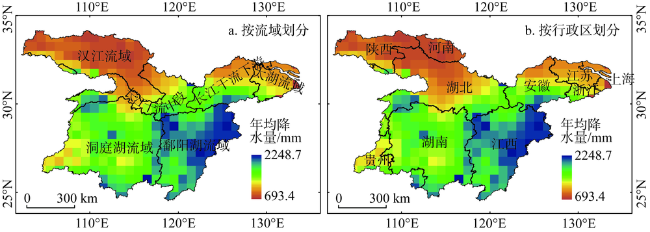
长江中下游地区位于106°5′~121°54′E和24°29′~34°11′N,包括长江干流的中下游、洞庭湖流域、鄱阳湖流域、汉江流域和太湖流域,面积约8.02×10⁵ km2,见图1a。气候类型属于北亚热带季风气候区,四季分明,雨热同期,降水量的50%以上集中在6-8月,且降水量的年际变化大,尤其是夏季降水。从空间分布上看,自东南向西北,年均降水量从2248.7 mm下降至693.4 mm。7月中旬至8月随着季风雨带的北推西移,长江中下游地区受副热带高压控制,高温少雨,常形成伏旱天气。10月梅雨结束后西太平洋副热带高压再次控制长江中下游地区,易形成伏秋连旱[19]
Fig. 1 Spatial distribution of annual precipitation in the middle and lower reaches of the Yangtze River from 1961 to 2015

图1 1961-2015年长江中下游地区年均降水量空间分布

1.2 数据来源

1961-2015年中国地面降水月值0.5°×0.5°格点数据集(V2.0)来源于中国气象数据网(http://data.cma.cn/),该数据是基于国家气象信息中心基础资料专项整编的中国地面2472个台站降水资料,利用ANUSPLIN软件的薄板样条法插值而成,共4189个有效格点。所有的格点数据文件均进行严格的质量检测、质量控制、数据核查、数据更正及补录。数据评估结果表明,格点值与站点观测值均方根误差平均为0.49 mm,相关系数平均达0.93(通过α=0.01的显著性检验),表明该数据集具有较好的精度和理想的插值效果[18,20]
为了使栅格数据能够与研究区的矢量边界严格重合,作者在ArcGIS 10.4中对格点数据集进行了栅格—矢量转换,并利用长江中下游地区的矢量边界(来源于:http://lake.geodata.cn)裁减得到该区域多年平均降水量的空间分布(图1),共374个格点。

1.3 标准化降水指数(SPI)

Mckee等[21]提出的SPI指数可以分析不同时间尺度的干旱事件,以及识别不同的干旱类型,具体计算步骤参见《气象干旱等级(GB/T20481-2006T)》[22],干旱等级的划分见表1。Keyantash等[23]通过统计方法测试了18种不同干旱指数的稳健性,结果表明SPI是识别干旱和量化干旱历时、干旱烈度及干旱空间范围的最佳气候指标。本文分别选取3个月、6个月和12个月时间尺度的SPI(记为SPI-3、SPI-6和SPI-12)来研究长江中下游地区短期、中期和长期的干旱特征。
Table 1 Drought categories according to SPI value

表1 依据SPI的干旱等级划分

干旱等级 无旱 轻旱 中旱 重旱 特旱
SPI值 (-0.5,+∞) (-1.0,-0.5] (-1.5,-1.0] (-2.0,-1.5] (-∞,-2.0]

1.4 干旱事件识别

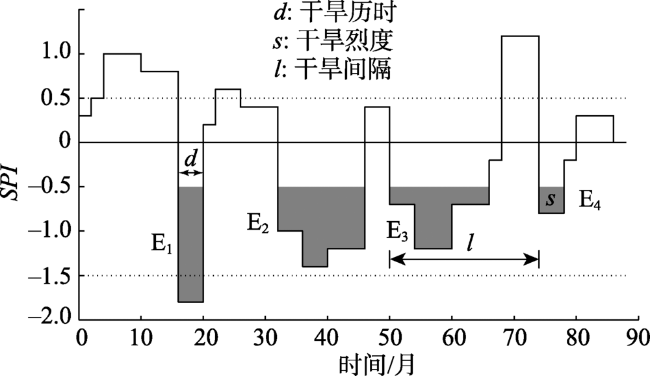
目前,应用最广泛的识别干旱事件的方法是游程理论[24],它可以容易地识别出干旱事件的干旱特征(例如:干旱历时、干旱烈度、烈度峰值和干旱间隔时间等)。干旱事件是指SPI小于截断水平(本文中为-0.5)的过程,小干旱事件和干旱事件合并的处理方法参见文献[9],图2中E1~E4是指4次干旱事件。干旱历时d指干旱事件持续的月份数。干旱间隔时间l指一次干旱开始时刻至下次干旱开始时刻的时间间隔。干旱烈度s为一次干旱事件SPI与-0.5之差的累计和。为方便计算,干旱烈度s取其相反数转成正值[9,25],即:
s = - i = 1 d SP I i (1)
Fig. 2 Sketch showing definition of drought events

图2 干旱事件的定义

对于每一个格点,平均干旱烈度Save、平均干旱历时Dave和烈度峰值Smax的计算公式如下:
S ave = i = 1 N s i N (2)
D ave = i = 1 N d i N (3)
S max = max s i 1 i N (4)
式中:N是干旱发生的次数。

1.5 Copula函数

构建干旱历时和干旱烈度二元Copula模型的主要步骤包括:(1)利用指数函数和伽马函数分别拟合干旱历时和干旱烈度的边缘分布,见式(5)、式(6);(2)选择Clayton Copula函数构建干旱历时和干旱烈度的联合分布,因为它具有简单有效、且能够较好地反映干旱尾部相关的特性,见式(7);(3)估计二元Copula模型中的参数θ
F D ( d ) = 1 - e - d λ , d > 0 (5)
F S ( s ) = 0 s t α - 1 β α Γ ( α ) e - t β d t , s > 0 (6)
F DS d , s = F D - θ ( d ) + F S - θ ( s ) - 1 - 1 / θ , θ 0 (7)
式中:FD(d)和FS(s)分别是干旱历时和干旱烈度的累积分布函数;FDS(d,s)是干旱历时和干旱烈度的联合分布函数;λ是指数分布的参数;αβ分别是伽马分布 Γ 的形状和尺度参数;θ是Clayton Copula函数的参数,用来衡量FD(d)和FS(s)关联程度。

1.6 干旱重现期和联合发生概率

工程中常用重现期来描述水文事件的严重性,但由于一次干旱事件可能持续多年或一年中发生多次干旱事件,故用于洪水频率分析中的重现期不适用于干旱特征研究[26]。Shiau等[27]推导出了干旱的单变量重现期,公式如下:
T D = E l / 1 - F D d (8)
T S = E l / 1 - F S s (9)
式中:TDTS分别是干旱历时和干旱烈度的重现期;E(l)为干旱间隔时间的数学期望。
由于干旱历时和干旱烈度的相关性,本文中考虑了两种类型的干旱历时和干旱烈度联合发生概率:(1)干旱历时和干旱烈度同时超过给定阈值的概率P1,见式(10);(2)干旱历时或干旱烈度中任一变量超过给定阈值的概率P2,见式(11)。
P 1 = P ( D d S s ) = 1 - F D d - F S s + F DS d , s (10)
P 2 = P ( D d S s ) = 1 - F DS d , s (11)
式中:ds分别对应单变量干旱历时和干旱烈度5年、10年、20年和30年重现期的值。

2 结果分析

2.1 区域干旱特征

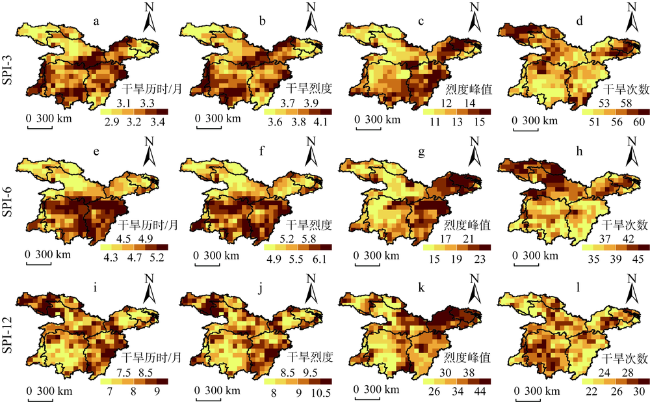
图3反映了1961-2015年不同时间尺度长江中下游地区干旱事件的平均干旱历时、平均干旱烈度、烈度峰值和干旱次数的空间分布,其渲染是采用等百分比分类符号化的方法。从3个月时间尺度来看,湖北省南部、湖南省西部和南部、江西省东南部及安徽省中部经历了相对更长的干旱历时,而汉江流域、江西南部和太湖流域平均干旱历时相对较短。平均干旱烈度的分布格局与平均干旱历时的空间格局是一致的。安徽中东部和江西东南部烈度峰值最大,表明这些地区经历了更强烈的干旱。陕西南部,江西南部和太湖流域的干旱发生次数更多,其空间格局与平均干旱历时、平均干旱烈度相反,表明这些地区干旱次数虽较多,但干旱的危害却相对较小。
Fig. 3 Spatial pattern of average duration, average severity, maximum severity and number of drought events obtained on the basis of SPI-3, SPI-6 and SPI-12 values, respectively

图3 平均干旱历时、平均干旱烈度、烈度峰值、干旱频次的空间格局

从6个月时间尺度看,长江干流以南区域的干旱历时较长;平均干旱烈度的分布格局与平均干旱历时的空间格局一致;6个月尺度的烈度峰值出现在长江下游地区;干旱发生频次的格局也较明显,长江干流以北区域明显多于以南区域。
从12个月时间尺度看,汉江流域中西部、鄱阳湖流域大部及长江干流中段的平均干旱历时较长,洞庭湖流域和长江干流下游平均干旱历时较短;干旱烈度的分布格局与干旱历时的分布格局大体一致;最严重的干旱发生在长江干流下游;而干旱次数的格局与3个月和6个月时间尺度的差异较大,洞庭湖流域平均干旱历时和平均干旱烈度虽较小,但干旱发生的频次相对较多。
不同时间尺度下的平均干旱历时和平均干旱烈度的空间分布均呈现一致性,这也意味着较长的干旱历时往往会导致更严重的干旱;最严重的干旱主要发生在长江下游地区,高频次干旱事件的空间覆盖范围随着时间尺度的增加而减小;长时间尺度的干旱特征与中短期的干旱特征空间格局差异较大。可见,时间尺度在区域干旱特征的研究中起着重要的作用,故应根据研究的目的选择合适的时间尺度。Mckee等[21]曾指出时间尺度能够区分不同类型的干旱,比如要研究农业干旱可以选择3个月或6个月的时间尺度,研究水文干旱则要选择9个月或12个月的时间尺度。

2.2 单变量分析

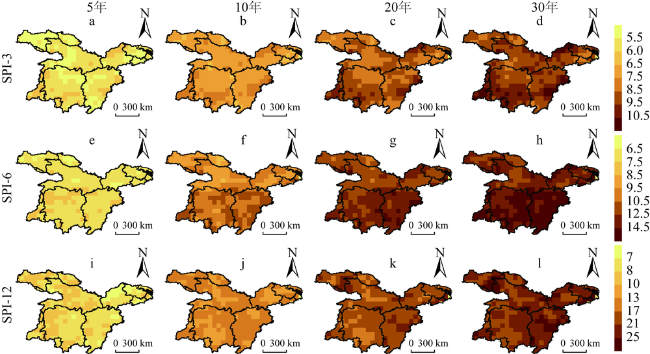
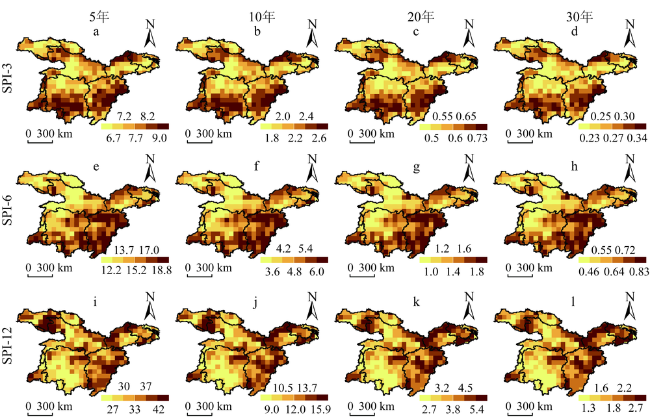
干旱烈度的强度随着不同时间尺度重现期的增加而增加(图4)。对于3个月的时间尺度,洞庭湖流域南部和鄱阳湖流域南部干旱较严重,汉江流域、洞庭湖流域东北部和太湖流域的干旱相对轻微。对于6个月的时间尺度,长江干流以南的大部以及安徽中部均发现了较严重的干旱。在12个月时间尺度干旱烈度上也表现出到类似6个月时间尺度的空间格局,然而,受严重干旱影响的区域空间范围有所缩小。
Fig. 4 Spatial patterns of 5 a, 10 a, 20 a, and 30 a return periods of drought severity derived on the basis of SPI-3, SPI-6 and SPI-12 values

图4 基于SPI-3、SPI-6和SPI-12值获取的5年、10年、20年和30年重现期的干旱烈度空间格局

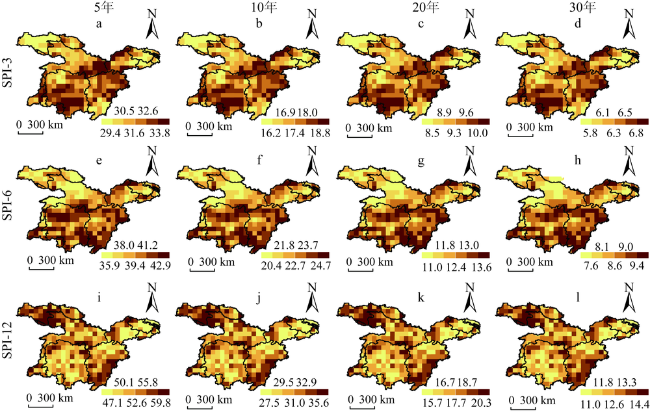
由对应干旱历时5年、10年、20年和30年重现期值的空间格局(图5),表明以较长的干旱历时为特征的区域也与更严重的干旱相关,反之亦然。干旱烈度大、干旱历时长的干旱事件主要发生在洞庭湖流域和鄱阳湖流域。干旱烈度小、干旱历时短的干旱事件主要发生在汉江流域。但是,应该指出的是单变量重现期得到的结果可能低于或超过实际情况,故利用双变量分析来进一步阐明长江中下游地区的干旱特征是有必要的。
Fig. 5 Spatial patterns of 5 a, 10 a, 20 a, and 30 a return periods of drought duration derived on the basis of SPI-3, SPI-6 and SPI-12 values

图5 基于SPI-3、SPI-6和SPI-12值获取的5年、10年、20年和30年重现期的干旱历时空间格局

2.3 双变量分析

图6为不同时间尺度下联合超越概率P1的空间模式。3个月时间尺度上,洞庭湖流域南部、鄱阳湖流域南部和安徽省中部有相对较大的P1值占主导,表明这些地区的干旱风险较高,其他区域的干旱风险则相对较低。6个月时间尺度上,鄱阳湖流域的干旱风险最高。12个月时间尺度上,除了鄱阳湖流域,长江干流下游地区的干旱风险相对也较高。不同时间尺度、不同重现期的干旱历时和干旱烈度的联合超越概率P1均呈现明显的空间分异,但高干旱风险区的空间格局有所不同。
Fig. 6 Spatial patterns of joint occurrence probability P1 of drought duration and severity

图6 干旱历时和干旱烈度的联合超越概率P1的空间格局

干旱历时和干旱烈度的联合超越概率P2的空间格局如图7所示。从总体上看,P2的覆盖范围与P1非常相似。但12个月时间尺度上,汉江流域的中西部干旱历时和干旱烈度的联合超越概率P2也较大。
Fig. 7 Spatial patterns of joint occurrence probability P2 of drought duration and severity

图7 干旱历时和干旱烈度的联合超越概率P2的空间格局

3 结论与讨论

3.1 结论

(1)平均干旱历时和平均干旱烈度的空间格局表明洞庭湖流域和鄱阳湖流域经受了严重的干旱。干旱历时和干旱烈度的空间分布格局大体上是一致的,即较严重的干旱事件通常持续更长的时间,反之亦然。长江干流以北区域干旱发生相对频繁,但严重程度相对较轻。不同时间尺度下,区域干旱特征的空间格局存在一定的差异。
(2)单变量分析中,不同时间尺度、不同重现期的干旱历时和干旱烈度的空间分布范围亦是一致的,这进一步表明干旱历时和干旱烈度是正相关的。干旱历时长、干旱烈度强度大的干旱事件主要发生在鄱阳湖流域。而较不强烈和历时较短的干旱事件主要发生在陕西南部、河南南部和湖北中部。
(3)基于Clayton Copula函数的双变量频率分析结果表明,鄱阳湖流域和长江干流下游的北部在不同时间尺度、不同重现期下的联合超越概率P1值均较大,表明这些区域的干旱风险较高。相反,陕西南部、河南南部、湖北大部和湖南中北部的联合超越概率P1值较小,表明这些地区的干旱风险相对较低。联合超越概率P2的空间格局与联合超越概率P1分布大体是一致的。

3.2 讨论

干旱历时和干旱烈度的联合分布取决于单变量边缘分布函数和Copula函数的选取。尽管许多学者[2,11,28]研究表明指数分布和伽马分布分别对干旱历时和干旱烈度的拟合最优,Clayton函数能够很好地反映干旱历时和干旱烈度的关联关系。但仍有不少学者由于采用的数据、干旱指数的选取不同而得到不同的结论。如Liu等[16]基于标准化降水蒸散指数(SPEI)获取中国大陆的干旱历时和干旱烈度,表明对于大部分气象站点指数分布和韦伯分布分别是拟合干旱历时和干旱烈度的最佳选择;肖名忠等[29]和Zhang等[14]通过比较多种Copula函数,分别指出Gumbel-Hougaard Copula更适宜用来分析珠江流域和云南省干旱联合分布的重现期;Xu等[30]基于Copula函数对中国西南地区干旱频率分析研究中得出广义帕累托分布对于干旱烈度的拟合最优,Joe Copula函数能更好地反映干旱历时和干旱烈度的相关性结构。即使对于同一组数据,基于不同的拟合优度指标最终选取的最优单变量边缘分布函数和Copula函数也可能会存在不同,而本文对单变量的边缘分布函数和Copula函数的敏感性没有进行评价[9]。此外,在进行干旱风险评价时,仅仅考虑干旱历时和干旱烈度两个干旱变量联合分布是不够的。干旱是一个非常复杂的过程,其风险评估还包含其他变量,例如干旱间隔时间和干旱面积等。因此,评价干旱频率分析方法对于干旱变量边缘分布函数和Copula函数选取的敏感性,以及建立多个干旱变量的联合分布将是作者未来研究的重点方向。

The authors have declared that no competing interests exist.

[1]
张强, 张良, 崔显成, 等. 干旱监测与评价技术的发展及其科学挑战. 地球科学进展, 2011, 26(7): 763-778.

[ZHANG Q, ZHANG L, CUI X C, et al.Progresses and challenges in drought assessment and monitoring. Advances in Earth Science, 2011, 26(7): 763-778.]

[2]
LIU C L, ZHANG Q, SINGH V P, et al.Copula-based evaluations of drought variations in Guangdong, South China. Natural Hazards, 2011, 59(3): 1533-1546.

[3]
周扬, 李宁, 吉中会, 等. 基于SPI指数的1981-2010年内蒙古地区干旱时空分布特征. 自然资源学报, 2013, 28(10): 1694-1706.

[ZHOU Y, LI N, JI Z H, et al.Temporal and spatial patterns of droughts based on standard precipitation index (SPI) in Inner Mongolia during 1981-2010. Journal of Natural Resources, 2013, 28(10): 1694-1706.]

[4]
翟禄新, 冯起. 基于SPI的西北地区气候干湿变化. 自然资源学报, 2011, 26(5): 847-857.

[ZHAI L X, FENG Q.Dryness/wetness climate variation based on standardized precipitation index in Northwest China. Journal of Natural Resources, 2011, 26(5): 847-857.]

[5]
吴贤云, 丁一汇, 王琪, 等. 近40年长江中游地区旱涝特点分析. 应用气象学报, 2006, 17(1): 19-28.

[WU X Y, DING Y H, WANG Q, et al.Characteristics of the recent 40-year flood/drought over the middle reaches of the Yangtze. Journal of Applied Meteorological Science, 2006, 17(1): 19-28.]

[6]
柳艳香, 赵振国, 朱艳峰, 等. 2000年以来夏季长江流域降水异常研究. 高原气象, 2008, 27(4): 807-813.

[LIU Y X, ZHAO Z G, ZHU Y F, et al.Research of JJA precipitation anomaly in Yangtze River Basin since 2000. Plateau Meteorology, 2008, 27(4): 807-813.]

[7]
王文, 许志丽, 蔡晓军, 等. 基于PDSI的长江中下游地区干旱分布特征. 高原气象, 2016, 35(3): 693-707.

[WANG W, XU Z L, CAI X J, et al.Aridity characteristic in middle and lower reaches of Yangtze River area based on palmer drought severity index analysis. Plateau Meteorology, 2016, 35(3): 693-707.]

[8]
SKLAR A.Fonctions de répartition àn dimensionset leurs marges. Publications de l'Institut de Statistique de L'Université de Paris, 1959, 8: 229-231.

[9]
李明, 张永清, 张莲芝. 基于Copula函数的长春市106年来的干旱特征分析. 干旱区资源与环境, 2017, 31(6): 147-153.

[LI M, ZHANG Y Q, ZHANG L Z.Analysis on drought characteristics of Changchun city in 106 years based on Copula function. Journal of Arid Land Resources and Environment, 2017, 31(6): 147-153.]

[10]
SHIAU J T.Fitting drought duration and severity with two-dimensional Copulas. Water Resources Management, 2006, 20(5): 795-815.

[11]
SHIAU J T, MODARRES R.Copula-based drought severity-duration-frequency analysis in Iran. Meteorological Applications, 2009, 16(4): 481-489.

[12]
闫宝伟, 郭生练, 肖义, 等. 基于两变量联合分布的干旱特征分析. 干旱区研究, 2007, 24(4): 537-542.

[YAN B W, GUO S L, XIAO Y, et al.Analysis on drought characteristics based on bivariate joint distribution. Arid Zone Research, 2007, 24(4): 537-542.]

[13]
MIRABBASI R, FAKHERI-FARD A, DINPASHOH Y.Bivariate drought frequency analysis using the Copula method. Theoretical and Applied Climatology, 2012, 108(1-2): 191-206.

[14]
ZHANG D D, YAN D H, LU F, et al.Copula-based risk assessment of drought in Yunnan province, China. Natural Hazards, 2015, 75(3): 2199-2220.

[15]
陈再清, 侯威, 左冬冬, 等. 基于修订Copula函数的中国干旱特征研究. 干旱气象, 2016, 34(2): 213-222, 268.

[CHEN Z Q, HOU W, ZUO D D, et al.Research on drought characteristics in China based on the revised Copula function. Journal of Arid Meteorology, 2016, 34(2): 213-222, 268.]

[16]
LIU X F, WANG S X, ZHOU Y, et al.Spatial analysis of meteorological drought return periods in China using Copulas. Natural Hazards, 2016, 80(1): 367-388.

[17]
MASUD M, KHALIQ M, WHEATER H.Analysis of meteorological droughts for the Saskatchewan River Basin using univariate and bivariate approaches. Journal of Hydrology, 2015, 522: 452-466.

[18]
董蕾, 张明军, 王圣杰, 等. 基于格点数据的西北干旱区极端降水事件分析. 自然资源学报, 2014, 29(12): 2048-2057.

[DONG L, ZHANG M J, WANG S J, et al.Extreme precipitation events in arid areas in Northwest China based on gridded data. Journal of Natural Resources, 2014, 29(12): 2048-2057.]

[19]
秦鹏程, 刘敏. 气象干旱诊断评估方法及其在长江中下游地区的应用. 长江流域资源与环境, 2015, 24(11): 1969-1976.

[QIN P C, LIU M.Methods for diagnosis and assessment of meteorological drought and application in the middle and lower Yangtze Basin. Resources and Environment in the Yangtze Basin, 2015, 24(11): 1969-1976.]

[20]
赵煜飞, 朱江, 许艳. 近50 a中国降水格点数据集的建立及质量评估. 气象科学, 2014, 34(4): 414-420.

[ZHAO Y F, ZHU J, XU Y.Establishment and assessment of the grid precipitation datasets in China for recent 50 years. Journal of the Meteorological Sciences, 2014, 34(4): 414-420.]

[21]
MCKEE T B, DOESKEN N J, KLEIST J.The relationship of drought frequency and duration to time scales//Proceedings of the Eighth Conference on Applied Climatology. American Meteorological Society Boston, 1993: 179-184.

[22]
张强, 邹旭恺, 肖风劲, 等. 气象干旱等级(GB/T 20481-2006). 北京: 中国标准出版社, 2006: 14-15.

[ZHANG Q, ZOU X K, XIAO F J, et al.Classification of Meteorological Drought (GB/T 20481-2006). Beijing: Standard Press of China, 2006: 14-15.]

[23]
KEYANTASH J, DRACUP J A.The quantification of drought: An evaluation of drought indices. Bulletin of the American Meteorological Society, 2002, 83(8): 1167-1180.

[24]
YEVJEVICH V M.An objective approach to definitions and investigations of continental hydrologic droughts. Hydrology Papers (No. 23), Colorado State University, Fort Collins, 1967.

[25]
陈璐, 郭生练, 闫宝伟, 等. 基于Copula函数的干旱特征分析. 水资源研究, 2012, 1(4): 186-194.

[CHEN L, GUO S L, YAN B W, et al.Drought characteristics analysis using Copulas. Journal of Water Resources Research, 2012, 1(4): 186-194.]

[26]
陆桂华, 闫桂霞, 吴志勇, 等. 基于Copula函数的区域干旱分析方法. 水科学进展, 2010, 21(2): 188-193.

[LU G H, YAN G X, WU Z Y, et al.Regional drought analysis approach based on Copula function. Advances in Water Science, 2010, 21(2): 188-193.]

[27]
SHIAU J T, SHEN H W.Recurrence analysis of hydrologic droughts of differing severity. Journal of Water Resources Planning and Management, 2001, 127(1): 30-40.

[28]
左冬冬, 侯威, 颜鹏程, 等. 基于游程理论和两变量联合分布的中国西南地区干旱特征研究. 物理学报, 2014, 63(23): 45-56.

[ZUO D D, HOU W, YAN P C, et al.Research on drought in Southwest China based on the theory of run and two-dimensional joint distribution theory. Acta Physica Sinica, 2014, 63(23): 45-56.]

[29]
肖名忠, 张强, 陈晓宏. 基于多变量概率分析的珠江流域干旱特征研究. 地理学报, 2012, 67(1): 83-92.

[XIAO M Z, ZHANG Q, CHEN X H.Spatial-temporal patterns of drought risk across the Pearl River Basin. Acta Geographica Sinica, 2012, 67(1): 83-92.]

[30]
XU K, YANG D W, XU X Y, et al.Copula based drought frequency analysis considering the spatio-temporal variability in Southwest China. Journal of Hydrology, 2015, 527: 630-640.

Outlines

/