中国农业绿色低碳发展绩效的双维差异分解及驱动因素
|
陈明华(1978- ),男,山东临沂人,博士,教授,博士生导师,研究方向为经济增长与绿色发展。E-mail: chenminghua1978@163.com |
收稿日期: 2024-12-30
修回日期: 2025-06-04
网络出版日期: 2025-09-05
基金资助
国家社会科学基金项目(22BJY191)
Dual-dimensional disparities and driving factors of green and low-carbon agricultural development performance in China
Received date: 2024-12-30
Revised date: 2025-06-04
Online published: 2025-09-05
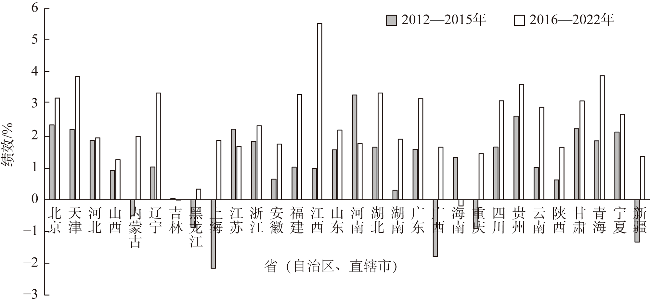
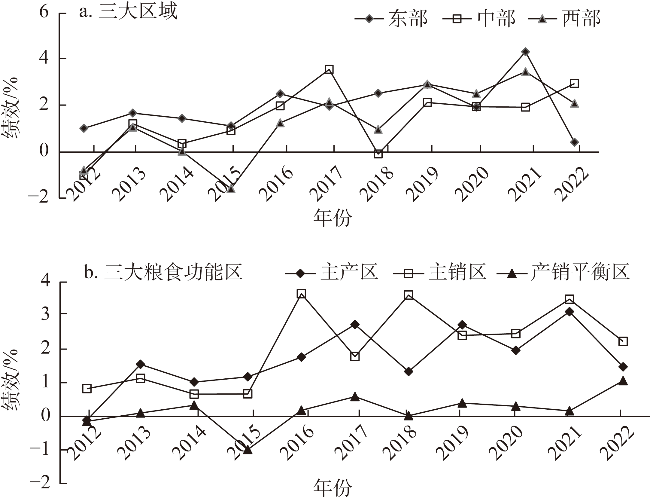
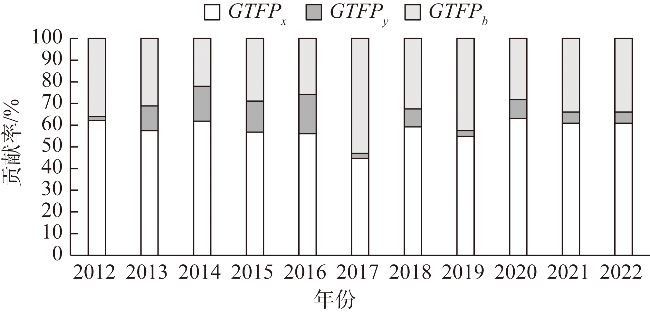
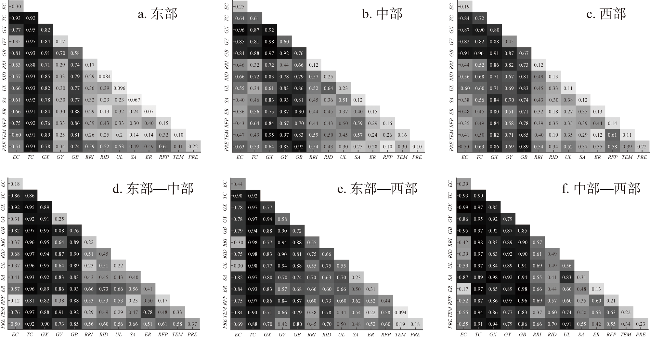
基于超效率EBM模型的Global-Luenberger指数测算了2012—2022年中国农业绿色低碳发展绩效,利用基尼系数双维分解法从空间和结构两个维度考察其区域差异,并借助最优参数地理探测器从内源和外源两方面综合分析区域差异的驱动因素。结果表明:(1)观测期内中国农业绿色低碳发展绩效整体呈上升态势,三大区域间呈现“东部>中部>西部”的发展格局,三大粮食功能区中主销区发展绩效最高,主产区次之。(2)农业绿色低碳发展绩效的区域差异整体呈收敛之势,区域间差异为总体差异在空间层面的主要来源,投入要素发展绩效差异则主导了结构层面的区域分化格局。(3)三大区域中,技术进步对东部区域内差异的作用强度较高,而中部、西部地区的区域差异易受农业工业化程度与财政支农水平空间差异的影响;三大粮食功能区中,平均气温与农业结构对主产区差异的影响程度相对高于主销区与产销平衡区。研究结论为优化区域农业发展策略、推动农业绿色低碳发展协调性以及提升农业高质量发展水平提供了重要支持。
陈明华 , 耿树伟 , 李亚婷 , 谢琳霄 . 中国农业绿色低碳发展绩效的双维差异分解及驱动因素[J]. 自然资源学报, 2025 , 40(9) : 2381 -2397 . DOI: 10.31497/zrzyxb.20250906
Based on the Global-Luenberger index derived from the super-efficiency EBM model, this study measures China's agricultural green and low-carbon development performance from 2012 to 2022. The regional disparities are examined from spatial and structural dimensions using the Gini coefficient bidimensional decomposition method, and the driving factors of regional differences are comprehensively analyzed from both endogenous and exogenous perspectives through the optimal parameters-based geographical detector. The results indicate that: (1) During the observation period, China's agricultural green and low-carbon development performance exhibited an overall upward trend, with the three major grain regions showing a development pattern of "eastern>central>western regions", and among the three functional zones, main sales areas achieved the highest development performance, followed by main production areas. (2) Regional disparities in agricultural green and low-carbon development performance demonstrated an overall convergence trend, with inter-regional differences serving as the primary source of overall spatial disparities, while differences in input factor development performance dominated the regional differentiation pattern at the structural level. (3) Among the three major regions, technological progress exerted a relatively high impact intensity on intra-regional disparities in the eastern region, whereas regional differences in the central and western regions were more susceptible to spatial variations in agricultural industrialization levels and fiscal support for agriculture. Among the three major grain functional zones, average temperature and agricultural structure had a relatively great impact on disparities in main production areas compared to main sales areas and production-sales balanced areas. The research findings provide important support for optimizing regional agricultural development strategies, promoting coordination in agricultural green and low-carbon development, and enhancing the quality of agricultural development.
表1 农业绿色低碳发展绩效指标评价体系Table 1 Evaluation system for performance indicators of green and low-carbon agricultural development |
| 指标类型 | 指标选取 | 指标说明 |
|---|---|---|
| 投入指标 | 土地投入 | 农作物总播种面积/千hm2 |
| 劳动力投入 | 第一产业从业人员/万人 | |
| 资本投入 | 农药使用量/万t | |
| 农用化肥施用折纯量/万t | ||
| 农用塑料薄膜使用量/t | ||
| 能源投入 | 农业机械总动力/万kW | |
| 水资源投入 | 农业用水量/亿m3 | |
| 期望产出指标 | 农业产出 | 第一产业增加值/亿元 |
| 碳汇 | 农业碳吸收/万t | |
| 非期望产出指标 | 面源污染 | 农业面源污染/万t |
| 碳源 | 农业碳排放/万t |
表2 空间维度下区域差异来源贡献率Table 2 Contribution rate of regional disparity sources under spatial dimension (%) |
| 年份 | G | 三大区域 | 三大粮食功能区 | |||||||||||
|---|---|---|---|---|---|---|---|---|---|---|---|---|---|---|
| G1 | G2 | G3 | G12 | G13 | G23 | Ga | Gb | Gc | Gab | Gac | Gbc | |||
| 2012 | 0.019 | 4.05 | 7.46 | 19.82 | 16.09 | 26.49 | 26.09 | 15.91 | 1.89 | 16.83 | 13.41 | 35.99 | 15.97 | |
| 2013 | 0.011 | 5.57 | 11.14 | 13.63 | 22.31 | 20.00 | 27.35 | 22.67 | 1.90 | 11.79 | 17.22 | 35.01 | 11.41 | |
| 2014 | 0.018 | 8.08 | 10.47 | 13.01 | 22.22 | 21.47 | 24.75 | 19.89 | 3.87 | 11.62 | 19.41 | 30.44 | 14.77 | |
| 2015 | 0.015 | 10.93 | 4.64 | 17.95 | 15.18 | 30.86 | 20.44 | 9.19 | 5.10 | 16.37 | 17.52 | 30.94 | 20.88 | |
| 2016 | 0.022 | 13.78 | 9.97 | 8.04 | 24.07 | 23.13 | 21.01 | 20.81 | 6.12 | 7.22 | 23.83 | 27.20 | 14.82 | |
| 2017 | 0.018 | 16.81 | 6.90 | 9.04 | 23.18 | 27.01 | 17.06 | 15.74 | 9.14 | 5.93 | 28.46 | 21.09 | 19.64 | |
| 2018 | 0.028 | 9.46 | 6.09 | 15.45 | 19.99 | 26.30 | 22.71 | 14.65 | 4.39 | 12.61 | 21.56 | 29.07 | 17.72 | |
| 2019 | 0.016 | 15.77 | 7.74 | 8.47 | 23.73 | 25.12 | 19.17 | 17.38 | 7.70 | 7.91 | 24.77 | 24.54 | 17.70 | |
| 2020 | 0.011 | 17.78 | 5.96 | 7.49 | 22.69 | 28.14 | 17.94 | 13.37 | 9.70 | 7.23 | 27.66 | 21.45 | 20.59 | |
| 2021 | 0.018 | 12.85 | 4.36 | 16.04 | 17.48 | 29.64 | 19.63 | 15.06 | 5.58 | 13.03 | 19.35 | 29.22 | 17.76 | |
| 2022 | 0.018 | 6.97 | 11.54 | 10.52 | 25.09 | 20.53 | 25.35 | 23.62 | 3.34 | 9.01 | 20.47 | 31.62 | 11.94 | |
注:G代表总体基尼系数,1、2、3分别表示东部、中部、西部;a、b、c分别表示粮食主产区、粮食主销区、粮食产销平衡区。 表示区域i的内部差距, 表示区域i和区域j之间的差距。 |
表3 观测期发展绩效的区域差异及其分解结果Table 3 Regional disparities and decomposition results of development performance during the observation period (%) |
| 构成 | 三大区域 | 三大粮食功能区 | |||||||
|---|---|---|---|---|---|---|---|---|---|
| GTFPx | GTFPy | GTFPb | 合计 | GTFPx | GTFPy | GTFPb | 合计 | ||
| Gw | 17.88 | 3.24 | 10.50 | 31.62 | 18.14 | 4.22 | 10.96 | 33.32 | |
| Gw1 | 6.89 | 0.49 | 3.72 | 11.10 | 8.79 | 2.72 | 5.60 | 17.11 | |
| Gw2 | 3.92 | 1.51 | 2.41 | 7.84 | 3.34 | 0.39 | 1.61 | 5.34 | |
| Gw3 | 7.07 | 1.24 | 4.37 | 12.68 | 6.01 | 1.11 | 3.75 | 10.87 | |
| Gb | 38.57 | 7.70 | 22.11 | 68.38 | 38.31 | 6.72 | 21.65 | 66.68 | |
| Gb12 | 11.74 | 2.83 | 6.52 | 21.09 | 12.46 | 2.20 | 6.58 | 21.24 | |
| Gb13 | 15.30 | 1.63 | 8.40 | 25.33 | 15.80 | 3.22 | 9.76 | 28.78 | |
| Gb23 | 11.53 | 3.24 | 7.19 | 21.96 | 10.05 | 1.30 | 5.31 | 16.65 | |
| G | 56.45 | 10.94 | 32.61 | 100.00 | 56.45 | 10.94 | 32.61 | 100 | |
注:1、2、3在三大区域中分别表示东部地区、中部地区、西部地区,在三大粮食功能区中分别表示粮食主产区、粮食主销区、粮食产销平衡区。 表示区域j的内部差距贡献率, 表示区域m和区域n之间的差距贡献率, 为区域内差距贡献率之和, 为区域间差距贡献率之和。 |
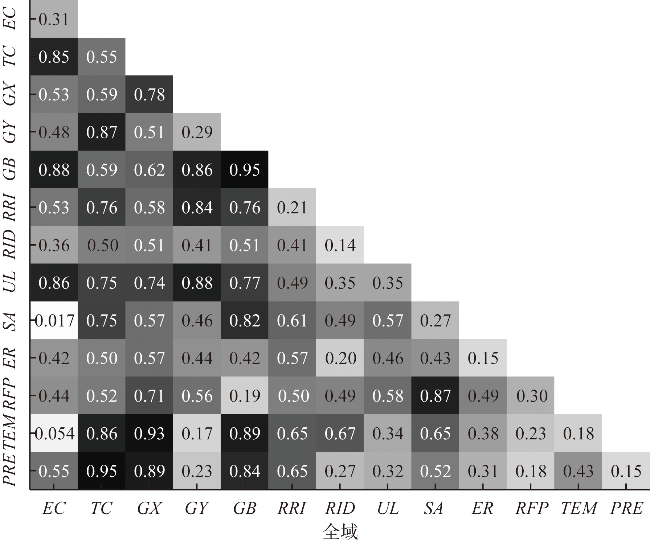
表4 全域影响因素及因子探测结果Table 4 Global Influencing Factors and Factor Detection Results |
| 分类 | 驱动因素 | 探测指标 | 离散方法 | 区间数量/个 | q值 | 排序 |
|---|---|---|---|---|---|---|
| 内源因素 | 技术效率改善 | EC | quantile | 6 | 0.31 | 5 |
| 技术进步 | TC | geometric | 6 | 0.55 | 3 | |
| 投入要素发展绩效 | GX | geometric | 4 | 0.78 | 2 | |
| 期望产出发展绩效 | GY | quantile | 6 | 0.29 | 7 | |
| 非期望产出发展绩效 | GB | geometric | 6 | 0.95 | 1 | |
| 外源因素 | 农村居民生活 | 农村居民人均可支配收入RRI | natural | 6 | 0.21 | 9 |
| 农业工业化程度 | 非农业产值与地区生产总值的比值RID | quantile | 6 | 0.14 | 13 | |
| 城镇化率 | 城镇人口比例UL | quantile | 4 | 0.35 | 4 | |
| 农业结构 | 粮食面积与农作物面积的比值SA | equal | 6 | 0.27 | 8 | |
| 环境规制水平 | 节能环保支出占财政支出比例乘以农业产值占地区生产总值比例ER | quantile | 6 | 0.15 | 11 | |
| 财政支农水平 | 农林水务支出占财政支出的比例RFP | equal | 6 | 0.30 | 6 | |
| 平均气温 | 年平均气温TEM | geometric | 5 | 0.18 | 10 | |
| 年降水量 | 年降水量PRE | geometric | 6 | 0.15 | 11 |
| [1] |
陈诚, 吴柯, 陈江龙. 基于投入品减量增效视角的长江经济带农业生产绿色化演进研究. 自然资源学报, 2024, 39(10): 2399-2417.
[
|
| [2] |
金书秦, 张哲晰, 胡钰, 等. 中国农业绿色转型的历史逻辑、理论阐释与实践探索. 农业经济问题, 2024, 45(3): 4-19.
[
|
| [3] |
杨骞, 王珏, 李超, 等. 中国农业绿色全要素生产率的空间分异及其驱动因素. 数量经济技术经济研究, 2019, 36(10): 21-37.
[
|
| [4] |
葛鹏飞, 王颂吉, 黄秀路. 中国农业绿色全要素生产率测算. 中国人口·资源与环境, 2018, 28(5): 66-74.
[
|
| [5] |
陆杉, 熊娇. 基于GWR的长江经济带农业绿色效率时空分异及影响因素研究. 地理科学, 2023, 43(2): 337-348.
[
|
| [6] |
李谷成, 陈宁陆, 闵锐. 环境规制条件下中国农业全要素生产率增长与分解. 中国人口·资源与环境, 2011, 21(11): 153-160.
[
|
| [7] |
崔许锋, 王雨菲, 张光宏. 面向低碳发展的农业生态效率测度与时空演变分析: 基于SBM-ESDA模型. 农业经济问题, 2022, 43(9): 47-61.
[
|
| [8] |
郭海红, 刘新民. 中国农业绿色全要素生产率时空演变. 中国管理科学, 2020, 28(9): 66-75.
[
|
| [9] |
史常亮. 土地流转对农业高质量发展的影响: 基于绿色全要素生产率视角. 自然资源学报, 2024, 39(6): 1418-1433.
[
|
| [10] |
姬志恒. 中国农业农村高质量发展的空间差异及驱动机制. 数量经济技术经济研究, 2021, 38(12): 25-44.
[
|
| [11] |
刘亦文, 欧阳莹, 蔡宏宇. 中国农业绿色全要素生产率测度及时空演化特征研究. 数量经济技术经济研究, 2021, 38(5): 39-56.
[
|
| [12] |
唐建军, 龚教伟, 宋清华. 数字普惠金融与农业全要素生产率: 基于要素流动与技术扩散的视角. 中国农村经济, 2022, (7): 81-102.
[
|
| [13] |
张青青, 曲衍波, 展凌云, 等. 中国粮食生产碳排放动态演进及驱动效应. 地理学报, 2023, 78(9): 2186-2208.
[
|
| [14] |
崔红茶, 陈新, 陈辞, 等. 长江流域少数民族特色村寨空间异质性及形成机理. 经济地理, 2023, 43(9): 160-171.
[
|
| [15] |
|
| [16] |
|
| [17] |
|
| [18] |
刘瑞翔, 安同良. 资源环境约束下中国经济增长绩效变化趋势与因素分析: 基于一种新型生产率指数构建与分解方法的研究. 经济研究, 2012, 47(11): 34-47.
[
|
| [19] |
|
| [20] |
|
| [21] |
刘华军, 孙东旭, 邵明吉. 中国人口城镇化高质量发展的空间差距及其双维分解. 财贸研究, 2024, 35(3): 17-28.
[
|
| [22] |
|
| [23] |
尹朝静, 杨坤, 田云. 中国农业生态全要素生产率增长: 经验事实、区域差异与动态演进. 中国农村经济, 2024, (2): 20-43.
[
|
| [24] |
尚杰, 杨滨键. 种植业碳源、碳汇测算与净碳汇影响因素动态分析: 山东例证. 改革, 2019, (6): 123-134.
[
|
| [25] |
陆杉, 唐佳欣, 熊娇. 财政分权与农业面源污染: 空间溢出与门槛特征. 中南大学学报: 社会科学版, 2022, 28(6): 67-77.
[
|
| [26] |
苏培添, 王磊. 数字普惠金融对中国农业碳排放强度影响的空间效应与机制. 资源科学, 2023, 45(3): 593-608.
[
|
| [27] |
吴康, 张文忠, 张平宇, 等. 中国资源型城市的高质量发展:困境与突破. 自然资源学报, 2023, 38(1): 1-21.
[
|
| [28] |
李娜, 张馨月, 张美慧. 中国智慧农业发展指数测度与分析. 经济与管理评论, 2025, 41(1): 135-147.
[
|
| [29] |
贾兴梅, 丁雨凡. 要素配置、生产率提升与乡村产业发展: 文献述评与研究展望. 经济与管理评论, 2024, 40(6): 110-119.
[
|
/
| 〈 |
|
〉 |