




景迈山古茶林文化景观遗产保护与利用的十大现实议题
|
唐雪琼(1969- ),女,云南弥勒人,硕士,教授,博士生导师,研究方向为风景遗产保护、自然保护地社区发展。E-mail: 396464545@qq.com |
收稿日期: 2025-10-07
修回日期: 2026-02-24
网络出版日期: 2026-05-22
基金资助
国家自然科学基金项目(42171240)
国家自然科学基金项目(42401225)
Ten practical issues in the protection and utilization of the Cultural Landscape of the Old Tea Forests of Jingmai Mountain
Received date: 2025-10-07
Revised date: 2026-02-24
Online published: 2026-05-22
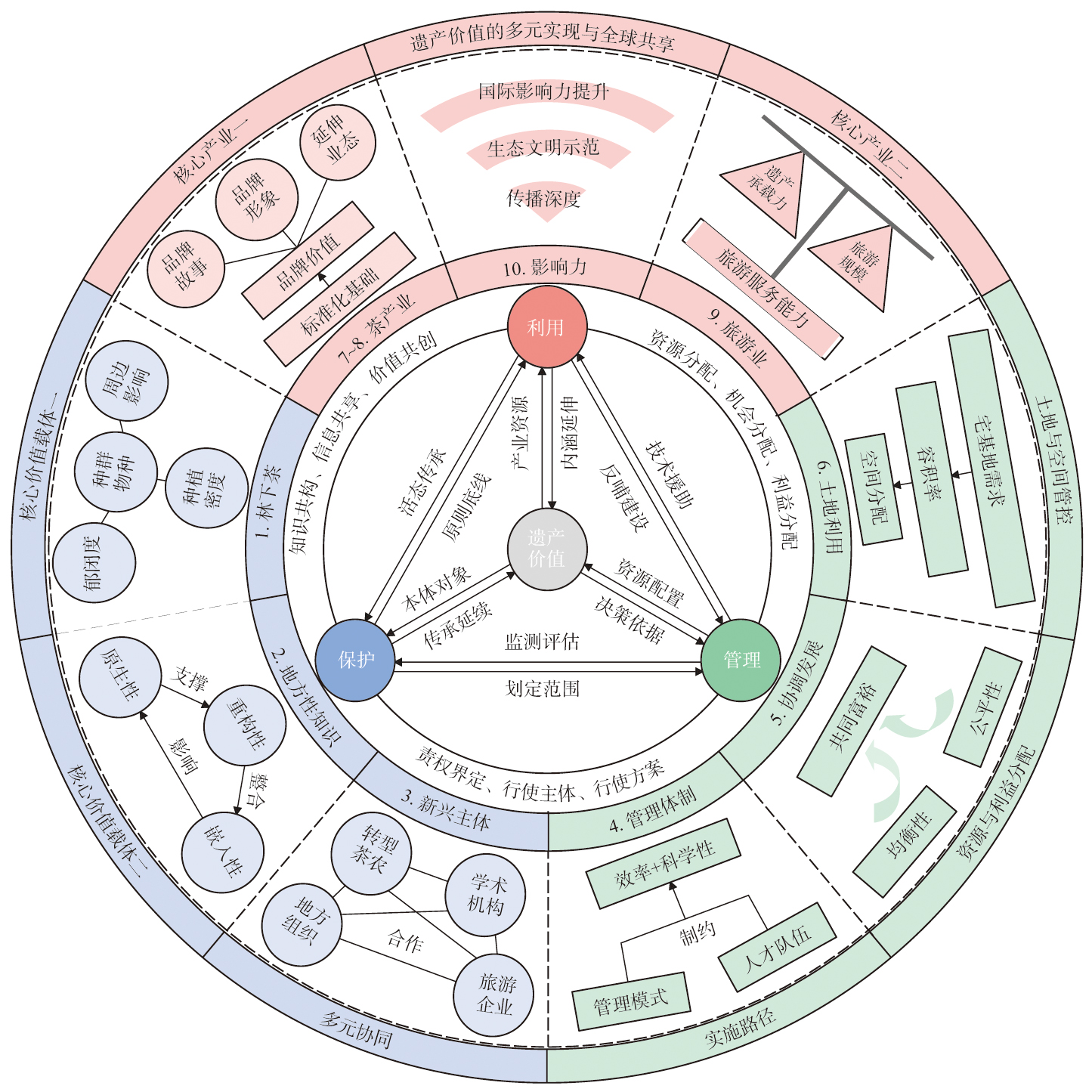
景迈山古茶林文化景观作为“人与自然和谐共生”的活态世界文化遗产,既承载着布朗族、傣族等世居民族的生态智慧与农耕文化,又在申遗后迅速融入旅游、品牌与市场体系,其保护与发展是践行习近平生态文明思想推动乡村振兴的实践样本,亦是探索活态文化遗产治理理论创新的前沿课题。通过田野调查与多源数据分析,系统梳理景迈山世界遗产在保护、管理与利用中面临的现实议题:保护维度聚焦林下茶共生生态的可持续性、地方性知识的传承创新以及多元主体的保护参与效能;管理维度侧重管理体制及人才队伍优化、均衡与公平发展路径以及土地空间管控;利用维度涉及茶叶产销标准化、品牌价值塑造、遗产与旅游价值共创以及遗产影响力的全球传播。这些议题相互交织,保护为管理与利用划定生态、文化底线,管理为保护与利用搭建协同框架,利用则为保护与管理注入可持续动力。结合问题分析,后申遗时代景迈山遗产地的可持续发展需重点关注:(1)面向遗产保护的理论创新与方法融合,以复合生态系统理论优化林茶共生调控、以活态传承理论活化地方性知识、以多主体协同理论完善治理机制。(2)提升管理效能的政策协同与适应治理,构建自上而下的联动机制与自下而上的动态反馈体系。(3)响应国家战略的开发利用与本土实践,通过生态保护红线管控与“景迈山”品牌打造践行生态文明,依托茶文旅融合与社区自治助推乡村振兴。(4)统筹三大维度的价值共创与全球对话,通过文化符号提炼与国际对话实现“地方性全球表达”。通过理论创新、技术赋能、机制完善与国际合作,景迈山不仅能实现自身遗产价值的永续传承,更将为全球活态文化遗产保护提供兼具中国特色与普适性的治理方案,推动人类文明的共同进步。
唐雪琼 , 彭科 , 吕光耀 , 李青 , 苏志龙 . 景迈山古茶林文化景观遗产保护与利用的十大现实议题[J]. 自然资源学报, 2026 , 41(7) : 1959 -1972 . DOI: 10.31497/zrzyxb.20260701
As a living world cultural heritage site exemplifying "harmonious coexistence between man and nature", the Cultural Landscape of the Old Tea Forests of Jingmai Mountain embodies the ecological wisdom and farming culture of the Bulang and Dai ethnic groups. Since its inscription, it has rapidly integrated into tourism, branding, and market systems, serving as a model for ecological civilization and rural revitalization, and a frontier topic for living heritage governance innovation. Based on fieldwork and multi-source data analysis, this paper addresses practical challenges in its protection, management and utilization. Protection focuses on the sustainability of tea-forest symbiotic, local knowledge transmission, and multi- stakeholders engagement. Management concerns governance optimization, talent development, equitable development, and landuse regulation. Utilization involves tea production standardization, brand building, heritage-tourism value co-creation, and global communication. These dimensions are interdependent: protection sets ecological and cultural boundaries, management provides a collaborative framework, and utilization drives sustainable momentum. To achieve post-inscription sustainable development, four priorities are proposed: (1) Theoretical and methodological integration for heritage conservation, using complex ecosystem, living heritage, and multistakeholder collaboration theories. (2) Policy coordination and adaptive governance to enhance efficiency via top-down linkage and bottom-up feedback. (3) Utilization aligned with national strategies, implementing ecological civilization through redline protection and brand building, and boosting rural revitalization via tea-culture-tourism integration and community self-governance. (4) Value co-creation and global dialogue as pathways to realize the glocal expression of local cultural symbols. Through theoretical innovation, technological empowerment, institutional improvement and international cooperation, Jingmai Mountain will sustain its heritage values and provide a Chinese-style, universally applicable governance model for the conservation of living cultural heritage worldwide, thereby contributing to the advancement of human civilization.
| [1] |
陶慧, 唐洁, 孙业红. 社会—生态系统视角下农业文化遗产的韧性演化与价值重塑: 以河北省邯郸市王金庄为例. 自然资源学报, 2025, 40(9): 2316-2333.
[
|
| [2] |
陈耀华, 秦芳. 乡村遗产的韧性能力与可持续演进: 以普洱景迈山古茶林文化景观遗产为例. 中国园林, 2023, 39(1): 65-71.
[
|
| [3] |
王博, 宋峰, 孙铁. 遗产话语视角下世界自然遗产保护的文化转向. 中国园林, 2022, 38(6): 86-90.
[
|
| [4] |
苏志龙, 韩斌, 唐雪琼. 景迈山古茶林对村落地方性的重构: 以芒景村为例. 广西民族研究, 2024, (1): 122-129.
[
|
| [5] |
史锋厚, 蒋学莉, 郁世军, 等. 林茶复合经营对茶叶品质的影响. 江苏农业科学, 2018, 46(13): 117-119, 124.
[
|
| [6] |
齐丹卉, 郭辉军, 崔景云, 等. 云南澜沧景迈古茶园生态系统植物多样性评价. 生物多样性, 2005, 13(3): 221-231.
[
|
| [7] |
陈爱国. 地方性知识与水环境治理: 以云南洱海水污染治理工程为例. 文化遗产, 2025, (2): 96-102.
[
|
| [8] |
吴灿. 农业文化遗产: 地方性知识的生成与演变. 湖南师范大学社会科学学报, 2024, 53(2): 33-41.
[
|
| [9] |
尹寿兵, 刘红婷. 国际旅游组织介入背景下山岳型景区治理演化路径研究. 自然资源学报, 2021, 36(5): 1316-1333.
[
|
| [10] |
|
| [11] |
邹统钎, 韩全, 李颖. 国家文化公园: 理论溯源、现实问题与制度探索. 东南文化, 2022, (1): 8-15.
[
|
| [12] |
谭传东, 洪歌, 吴雪飞. 协同生态系统服务与公平性的城市绿色空间配置优化: 以武汉市中心城区为例. 现代城市研究, 2024, (7): 24-29.
[
|
| [13] |
李晓钟, 张小蒂. 我国茶叶贸易基于标准化生产增进比较利益的分析. 农业经济问题, 2009, (3): 87-92.
[
|
| [14] |
|
| [15] |
张广海, 董跃蕾, 刘二恋. 新时代旅游资源协同开发对共同富裕影响的组态路径分析. 自然资源学报, 2024, 39(2): 259-273.
[
|
| [16] |
宋瑞. 旅游发展与文化遗产: 何以相促. 旅游学刊, 2024, 39(3): 10-12.
[
|
| [17] |
唐雪琼, 杨君杰. 世界文化遗产地景迈山的旅游化. 旅游学刊, 2025, 40(5): 7-9.
[
|
| [18] |
黄永林. 非物质文化遗产文化基因的结构特征和保护利用. 中央民族大学学报: 哲学社会科学版, 2024, 51(2): 114-123.
[
|
| [19] |
张颖岚, 刘骋. 空间正义视域下城市建成区文化遗产保护利用研究. 浙江大学学报: 人文社会科学版, 2023, 53(4): 16-27.
[
|
| [20] |
杨晓辉, 罗微, 陈华文, 等. 新时期非物质文化遗产的创新保护与传承利用: 体系、路径与挑战. 自然资源学报, 2025, 40(9): 2297-2315.
[
|
| [21] |
|
| [22] |
|
| [23] |
|
| [24] |
张艳, 苗长虹. 新时代黄河流域非物质文化遗产的保护传承与活化利用. 中州学刊, 2024, (11): 142-147.
[
|
| [25] |
伽红凯, 卢勇. 农业文化遗产供给侧改革: 矛盾表征、肇因分析与策略选择. 中国农业大学学报: 社会科学版, 2023, 40(5): 189-202.
[
|
| [26] |
王秀伟, 何军霞, 武秀杰. 黄河国家文化公园遗产保护与旅游利用的空间逻辑和协调机制. 山东社会科学, 2023, (11): 128-136.
[
|
| [27] |
汲忠娟, 徐红罡, 崔庆明. 旅游空间正义的实践路径: 基于西藏自治区的案例研究. 旅游导刊, 2022, 6(2): 26-42.
[
|
| [28] |
胡晓云, 万琰. 原型·文脉·现代化:中国地理标志农产品的品牌化. 杭州: 浙江大学出版社, 2025.
[
|
| [29] |
万婷婷. 法国乡村文化遗产保护体系研究及其启示. 东南文化, 2019, (4): 12-17.
[
|
| [30] |
李虎, 谢艳梅. 武陵民族地区传统村落铸牢中华民族共同体意识的历史基础和实践路径. 西北民族研究, 2025, (4): 17-28.
[
|
| [31] |
苏畅, 罗诗戈, 郭诗怡. 日本里山农业文化遗产景观保护和利用政策实施与经验解读. 中国园林, 2022, 38(4): 98-103.
[
|
| [32] |
张朝枝. 以文物推动文明对话的议题与路径. 旅游学刊, 2025, 40(1): 11-13.
[
|
/
| 〈 |
|
〉 |