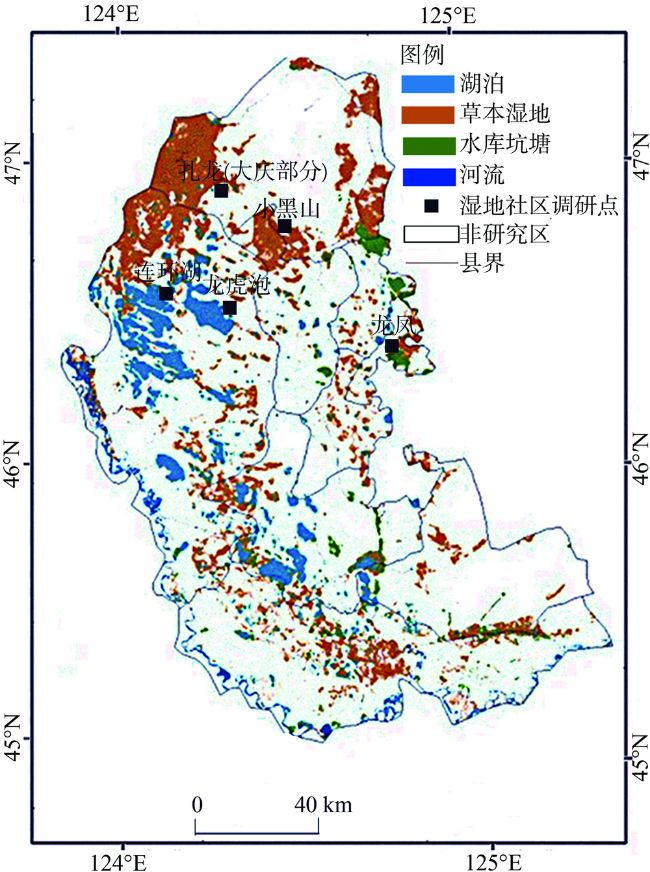
基于MNL离散选择模型的社区居民对湿地保护的贡献意愿——以大庆湿地为例
|
卢明强(1979- ),男,河南信阳人,硕士,讲师,研究方向为湿地生态、区域旅游规划。E-mail: 68112604@qq.com |
收稿日期: 2019-06-05
要求修回日期: 2019-12-04
网络出版日期: 2021-04-28
基金资助
大庆市哲学社会科学规划研究项目(DSGB2018082)
东北石油大学引导性创新基金项目(2018YDQ-11)
版权
The contribution willingness of community residents' protection of wetlands based on MNL Discrete Selection Model: A case study of Daqing wetland
Received date: 2019-06-05
Request revised date: 2019-12-04
Online published: 2021-04-28
Copyright
社区居民的贡献意愿研究是进行湿地保护的重要切入点。以大庆湿地社区为案例地,设计了“仅金钱”“仅劳动”“两者皆愿意”“两者皆不愿”4个贡献意愿类型,通过问卷调查统计社区居民的贡献意愿现状,并运用MNL模型分析社区居民个人特征对贡献意愿选择偏好的倾向性影响及边际影响。研究结论如下:第一,79.8%的社区居民对湿地保护具有贡献意愿,劳动贡献意愿高于金钱贡献意愿;第二,性别、年龄、月收入、受教育程度、加入环保组织、接受过环保教育为社区居民贡献意愿选择偏好的关键影响因素;第三,提高社区居民的受教育程度和月收入、让社区居民加入环保组织和进行环保宣传可以显著提升社区居民的贡献意愿水平。研究将劳动作为一种直观的贡献价值进行体现,使对贡献意愿的研究不再仅仅局限于货币形式。建议湿地管理者应重视针对湿地社区的环保宣传与环保组织运作,重视劳动形式在环保贡献中的重要作用。
卢明强 , 陈丽军 . 基于MNL离散选择模型的社区居民对湿地保护的贡献意愿——以大庆湿地为例[J]. 自然资源学报, 2021 , 36(2) : 449 -458 . DOI: 10.31497/zrzyxb.20210214
The study of community residents' contribution willingness is an important starting point for wetland conservation. Taking Daqing wetland community as an example, firstly, we design four types of contribution willingness: money-only, labor-only, both-money-and-labor, and neither-money-nor-labor. Then, we investigate and analyze the residents' present contribution willingness in the community by questionnaire. Finally, by using MNL model, we examine the tendential and marginal influences of the willingness types chosen according to the residents' characteristics. The results show that: firstly, 79.8% of the community residents have the contribution willingness, and the willingness of labor contribution is higher than that of money contribution. Secondly, the key factors affecting community residents' preference to contribution willingness are age, monthly income, education level, joining environmental protection organizations and receiving environmental education. Thirdly, the contribution willingness can be significantly enhanced by improving education level and monthly income of the community residents, allowing them to join the relevant organizations as well as disseminate knowledge of environmental protection. We regard labor as distinct presentation of contribution value, and contribution willingness is no longer limited to money. It is suggested that administrators should attach importance to environmental popularization and the operation of environmental protection organizations for wetland communities, and to the role of labor forms in environmental protection contribution.
Key words: wetland; community; MNL Discrete Selection Model; contribution willingness
表1 变量的基本统计特征Table 1 The basic statistical characteristics of the variables |
| 变量 | 特征样本 | 样本统计/个 | 均值 | 比例/% | ||
|---|---|---|---|---|---|---|
| 解释变量 | 性别X1 | 女=0 | 267 | 0.52 | 48.2 | |
| 男=1 | 287 | 51.8 | ||||
| 年龄X2 | 18岁以下=0 18~35岁=1 | 56 175 | 1.70 | 10.1 31.6 | ||
| 36~59岁=2 | 203 | 36.6 | ||||
| 60岁以上=3 | 120 | 21.6 | ||||
| 受教育程度X3 | 初中及以下=0 | 259 | 0.94 | 46.8 | ||
| 高中=1 | 152 | 27.4 | ||||
| 大专=2 | 76 | 13.7 | ||||
| 本科=3 | 54 | 9.8 | ||||
| 硕士及以上=4 | 13 | 2.3 | ||||
| 月收入X4 | 1000元以下=0 | 95 | 1.55 | 17.1 | ||
| 1001~3000元=1 | 197 | 35.6 | ||||
| 3001~5000元=2 | 150 | 27.1 | ||||
| 5001~8000元=3 | 88 | 15.9 | ||||
| 8001元以上=4 | 24 | 4.3 | ||||
| 接受过环保教育X5 | 否=0 | 422 | 0.24 | 76.2 | ||
| 是=1 | 132 | 23.8 | ||||
| 加入了环保组织X6 | 否=0 | 498 | 0.10 | 89.9 | ||
| 是=1 | 56 | 10.1 | ||||
| 被解释变量 | 贡献意愿集C | 两者皆愿意C0=0 | 267 | 1.18 | 48.2 | |
| 仅金钱C1=1 | 35 | 6.3 | ||||
| 仅劳动C2=2 | 140 | 25.3 | ||||
| 两者皆不愿C3=3 | 112 | 20.2 | ||||
表2 社区居民个人特征对贡献意愿选择偏好的倾向性影响Table 2 The tendential effect of the communities' characteristics to the preference of willingness choice |
| 个人特征(解释变量X) | C1 vs C0 | C2 vs C0 | C3 vs C0 |
|---|---|---|---|
| 常数 | 1.086 | 2.728 | 2.505 |
| 性别X1 | -0.114 | 0.748* | -0.004 |
| 年龄X2 | -0.052* | 0.572* | 0.347** |
| 受教育程度X3 | 0.463** | -0.137 | -0.671* |
| 月收入X4 | 0.437** | -0.219* | -0.442 |
| 接受过环保教育X5 | -0.539 | 0.025 | -0.724** |
| 加入了环保组织X6 | -0.417 | 0.026 | -0.865** |
注:**、*分别表示在0.01、0.05水平上显著。 |
表3 湿地社区居民特征变化对贡献意愿偏好的边际影响Table 3 The marginal effect of the communities' characteristics changes to the preference of willingness choice (%) |
| 旅游者特征X | C0 | C1 | C2 | C3 |
|---|---|---|---|---|
| 性别X1 | 0.441 | -2.137 | 5.621 | -3.925 |
| 年龄X2 | -0.028 | -7.816 | 3.462 | 4.382 |
| 受教育程度X3 | 2.241 | 3.362 | -4.416 | -1.187 |
| 月收入X4 | 1.352 | 4.097 | -4.661 | -0.788 |
| 接受过环保教育X5 | 4.712 | -0.521 | 1.895 | -6.086 |
| 加入了环保组织X6 | 6.237 | -0.326 | 2.028 | -7.939 |
| [1] |
|
| [2] |
彭凯锋, 蒋卫国, 邓越. 武汉城市圈湿地受损程度识别及驱动因素分析. 自然资源学报, 2019,34(8):1694-1707.
[
|
| [3] |
徐网谷, 高军, 夏欣, 等. 中国自然保护区社区居民分布现状及其影响. 生态与农村环境学报, 2016,32(1):19-23.
[
|
| [4] |
马玉龙, 马明国, 刘馨橘, 等. 张掖国家湿地公园建设与发展问卷调查分析. 湿地科学与管理, 2015,11(3):43-45.
[
|
| [5] |
戴胡萱, 李俊鸿, 程鲲, 等. 三江平原保护区社区居民对湿地生态系统服务功能的贡献意愿. 自然资源学报, 2017,32(6):977-987.
[
|
| [6] |
蔡志坚, 杜丽永, 蒋瞻. 条件价值评估的有效性与可靠性改善: 理论、方法与应用. 生态学报, 2011,31(10):2915-2923.
[
|
| [7] |
佟锐. 基于廉价磋商方法的CVM假想偏差修正与实证研究. 哈尔滨: 东北农业大学, 2016.
[
|
| [8] |
于文金, 谢剑, 邹欣庆. 基于CVM的太湖湿地生态功能恢复居民支付能力与支付意愿相关研究. 生态学报, 2011,31(23):7271-7278.
[
|
| [9] |
高琴, 敖长林, 毛碧琦, 等. 基于计划行为理论的湿地生态系统服务支付意愿及影响因素分析. 资源科学, 2017,39(5):893-901.
[
|
| [10] |
高琴, 敖长林, 陈红光, 等. 基于居民生态认知的非使用价值支付意愿空间分异研究: 以三江平原湿地为例. 生态学报, 2014,34(7):1851-1859.
[
|
| [11] |
|
| [12] |
王灿, 王德, 朱玮, 等. 离散选择模型研究进展. 地理科学进展, 2015,34(10):1275-1287.
[
|
| [13] |
张艳. 自然保护区社区参与行为的影响因素研究: 以兴凯湖国家级自然保护区为例. 生态经济, 2015,31(3):157-160.
[
|
| [14] |
顾恩国, 何秀川, 方自成. 两个专属渔业资源区的离散动力学模型的分叉分析. 中南民族大学学报: 自然科学版, 2015,34(3):105-110.
[
|
| [15] |
|
| [16] |
冯颖. 宁夏干旱半干旱地区农户采用农业节水技术意愿的影响因素分析. 中国农村水利水电, 2016, (5):48-54.
[
|
| [17] |
李广东, 邱道持, 王平, 等. 基于忠县农户调查的耕地保护经济补偿机制需求分析. 中国土地科学, 2010,24(9):33-39.
[
|
| [18] |
刘畅, 王继富. 5个时期黑龙江省天然湿地动态及其影响因素研究. 湿地科学, 2017,15(1):80-84.
[
|
| [19] |
|
| [20] |
张瑶, 徐涛, 赵敏娟. 生态认知、生计资本与牧民草原保护意愿: 基于结构方程模型的实证分析. 干旱区资源与环境, 2019,33(4):35-42.
[
|
| [21] |
葛继红, 徐慧君, 杨森, 等. 基于Logit-ISM模型的污染企业周边农户环保支付意愿发生机制分析: 以苏皖两省为例. 中国农村观察, 2017, (2):93-106.
[
|
| [22] |
|
| [23] |
刘俊, 张恒锦, 金朦朦, 等. 旅游地农户生计资本评估与生计策略选择: 以海螺沟景区为例. 自然资源学报, 2019,34(8):1735-1747.
[
|
/
| 〈 |
|
〉 |